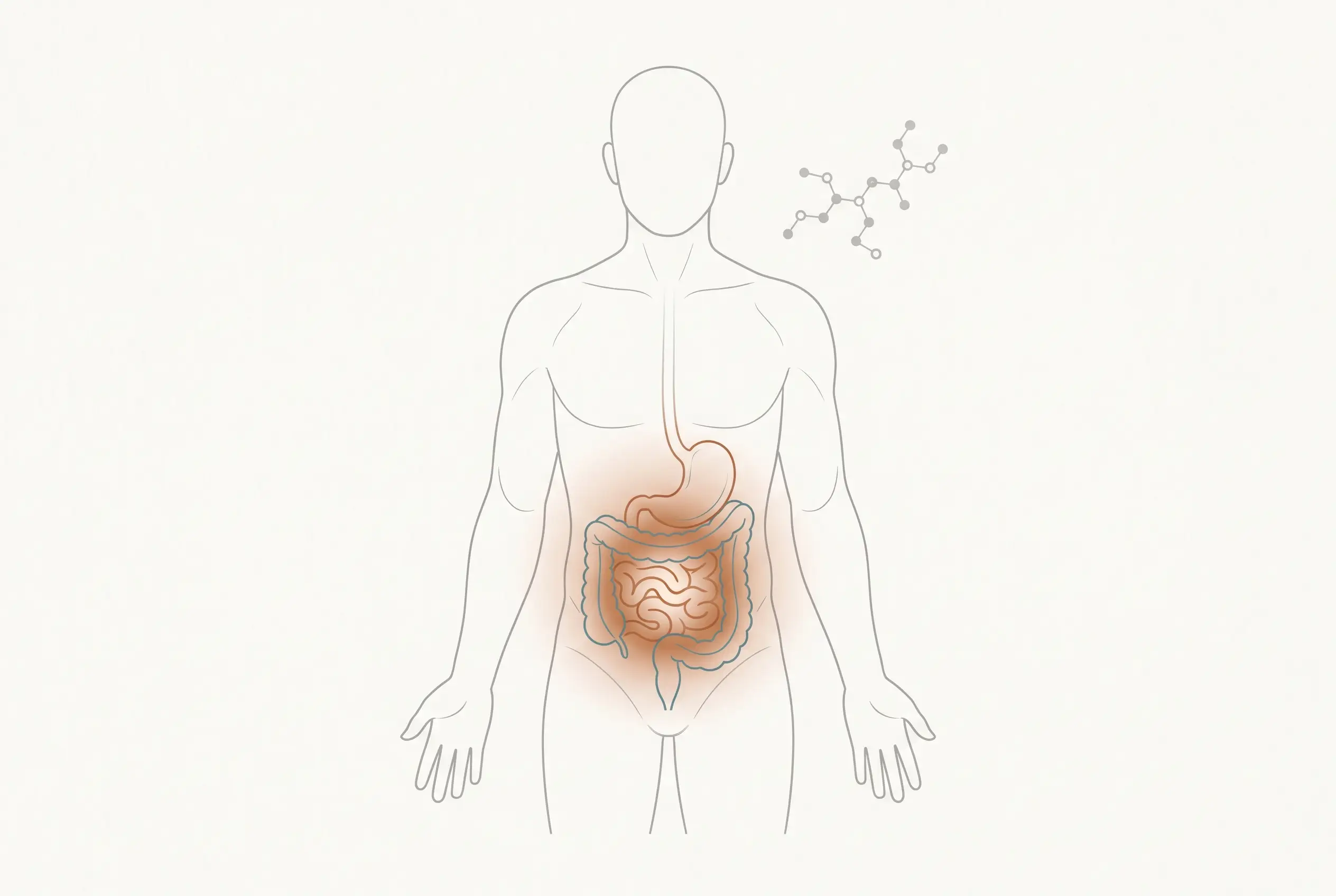
Larazotide is one of the few gut peptides that was actually tested in people, in proper placebo-controlled trials. That's worth knowing. So is the rest of the story: the results were mixed, and the big confirmatory trial ended without posted results.
What Larazotide actually is
Larazotide is a man-made peptide, a short chain of amino acids (the tiny building blocks that make up protein). It's also called AT-1001 or larazotide acetate, and it's taken by mouth in trials. It's designed to act on tight junctions: the tiny 'seals' between the cells lining your gut. The idea is to stop those seals opening, which is where the popular phrase 'leaky gut' comes in.
What it's studied for
In human research, larazotide has been tested for:
- Ongoing symptoms in people with celiac disease who already follow a gluten-free diet
- Limiting the reaction when people with celiac disease are given gluten on purpose (a 'gluten challenge')
- Gut permeability, measured with a sugar test (the lactulose to mannitol ratio)
That's a much more specific, testable goal than the vague 'gut healing' claims around many peptides.
What the evidence really shows
Permeability didn't budge. In two gluten challenge trials, one with 86 patients and one with 184, larazotide showed no significant difference from placebo on the gut permeability test. In the smaller trial, the test was too variable in outpatients to judge properly (PMIDs 22825365 and 23163616). Both trials did report less symptom worsening at some lower doses.
Symptom results were mixed. In the largest published trial, 342 adults with ongoing celiac symptoms on a gluten-free diet were given one of three doses or placebo for 12 weeks. Only the lowest dose beat placebo on the main symptom score. The two higher doses didn't, and the authors themselves describe the results as mixed (PMID 25683116). Side effects were reported as comparable with placebo.
Phase 3 ended without results. The Phase 3 trial (NCT03569007) enrolled 307 people. ClinicalTrials.gov lists it as terminated, with a completion date of July 2022. As of 15 September 2026, the record shows no posted results and no stated reason for stopping. So we can't tell you why it stopped or how it went. We also found no approval for larazotide in the records we checked.
What the research points to
- A clear, testable idea: acting on the gut lining's tight junctions
- Real placebo-controlled human trials in celiac disease
- Some symptom benefit at lower doses in some trials
What it does NOT prove
- That it's a proven or approved treatment
- That it fixes 'leaky gut': two trials found no permeability difference from placebo
- That products outside a trial are what was tested, or are safe
About 'leaky gut'
'Leaky gut' is a popular marketing phrase, not a clinical endpoint. Larazotide gets pulled into those conversations because of how it's designed to work. But when trials actually measured gut permeability, larazotide didn't show a difference from placebo. For the bigger picture on gut peptides, including BPC-157, KPV and teduglutide, see peptides for gut health.
Who talks about it, and why to be careful
Larazotide comes up in gut health circles, where 'it reached Phase 3' can make it sound approved. It isn't approved in any record we found. If you have celiac disease or ongoing gut symptoms, that's a matter for a qualified doctor.
What this does not mean
- This does not mean larazotide is proven or approved. Its human results were mixed and its Phase 3 has no posted results.
- This does not mean larazotide was proven not to work. The terminated Phase 3 leaves the question open.
- This is general education, not medical advice or a recommendation to use larazotide.