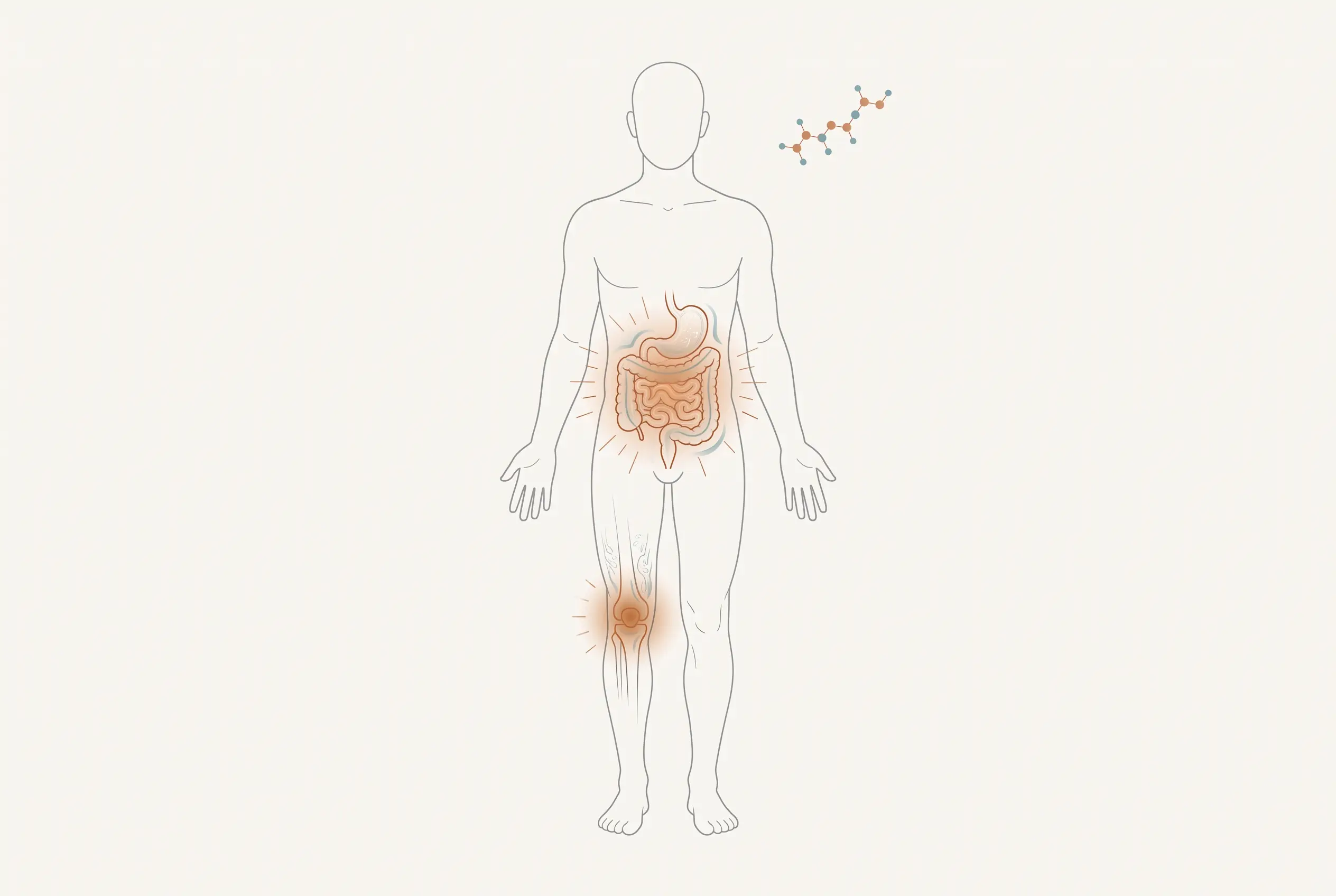
BPC-157 is one of the most talked-about peptides online, usually for healing and recovery. It's also one of the most over-hyped. Here's the honest picture: an interesting idea, a lot of animal research, very little human proof, and no approval as a medicine.
What BPC-157 actually is
BPC-157 is a man-made peptide: a short chain of 15 amino acids (the tiny building blocks that make up protein). The name stands for "Body Protection Compound." It's based on a small part of a protein found naturally in stomach fluid. The version people talk about is made in a lab; it doesn't exist as a ready-made product in nature.
What it's studied for
In research, mostly on rats, BPC-157 has been looked at for:
- Healing tendons, ligaments, and muscle after injury
- Gut problems, like ulcers and inflammation (in animals only, see below)
- Calming inflammation in general
On paper that sounds exciting. The catch is in the word "rats."
Does BPC-157 actually work?
Almost all the promising BPC-157 results come from animal studies, mostly in rats. Animal results are a starting point, not proof: lots of things that work in rats never pan out in people. There are very few proper human studies, so we simply don't have solid evidence for how well it works, or how safe it is, in humans.
BPC 157 rapidly increases various genes expression in rat excision skin wound.
Frontiers in Pharmacology, 2021 (PMID 34267654)
That's a fair summary of the state of play: real, repeatable effects in rats, described in rat terms. Nobody has shown the same thing happens usefully in a human tendon or gut.
What about the gut?
The gut is where BPC-157 hype is loudest, and the human evidence is thinnest. As of 15 September 2026, we found no full published human trial of BPC-157 for any gut condition on PubMed or ClinicalTrials.gov. The only human gut data we know of is a 2005 conference abstract: a placebo-controlled Phase 2 study of a BPC-157 (PL 14736) enema in 53 people with mild to moderate ulcerative colitis. When the FDA reviewed BPC-157 in July 2026, it said that abstract left out too much (how the main score was defined, who could join, the statistics, follow-up) to support either effectiveness or safety. Almost all the gut results come from animals, for example rats with surgically made fistulas between the colon and skin (PMID 18818478).
Papers from the research group behind those rat studies say BPC-157 was in clinical trials for inflammatory bowel disease under the code PL 14736 (PMID 18818478). That 2005 abstract is the only report of those trials we could find: no registry record and no full published results. A 2025 systematic review of BPC-157 found 35 preclinical studies, just 1 clinical study (on knee pain, not the gut), and no clinical safety data (PMID 40756949). For the full comparison with other gut peptides, see peptides for gut health.
Is BPC-157 legal to buy?
BPC-157 is often sold online as a "research chemical," a label that lets sellers move it without meeting medicine rules. That label does not make it an approved medicine. Here is where it stands with the main bodies we checked, as of September 15, 2026:
- FDA (United States): not approved. In its briefing document for a July 2026 advisory committee meeting, the FDA says it is not a component of any FDA-approved drug, and that its search found no approved product containing BPC-157 in any country.
- FDA compounding: not on the list. BPC-157 is not on the FDA's 503A bulks list, the list of bulk substances US pharmacies may use to compound drugs (21 CFR 216.23). It was once in the FDA's Category 2, substances that may present significant safety risks. The FDA now lists it among substances previously in that category whose nominations were withdrawn, and still describes the concerns: possible immune reactions, peptide impurities, and little or no safety information.
- FDA advisory review, July 2026: no final decision. FDA staff evaluated BPC-157 for ulcerative colitis and proposed not adding it to the 503A list, saying it is not well characterized chemically, that information on its safety and immune-reaction risks is lacking, and that there is not enough evidence to conclude it works for ulcerative colitis. The FDA's Pharmacy Compounding Advisory Committee voted on the question on July 23, 2026. That vote is advice to the FDA, not a decision, and BPC-157 had not been added to the list as of September 15, 2026.
- Sport (WADA): prohibited at all times. The World Anti-Doping Agency's 2026 Prohibited List, in force since 1 January 2026, names BPC-157 in section S0 (non-approved substances), which is banned in and out of competition. The U.S. Anti-Doping Agency (USADA) also describes it as prohibited under S0.
Rules outside the US differ by country, and we did not check each one. And "sold online as a chemical" is not the same as "legal or safe to use on yourself."
What the research points to
- Interesting healing effects in animal (mostly rat) studies
- A reason scientists find it worth studying further
- Early, unproven promise for tissue and gut repair
What it does NOT prove
- That it safely heals injuries in humans
- That it heals the human gut: the only human gut data is one 2005 conference abstract, which the FDA found inadequate
- That it's safe to inject: human safety isn't established
- That it's an approved or legal medical treatment
Who talks about it, and why to be careful
BPC-157 is popular in fitness, biohacking, and injury-recovery circles, where people share "cycles" and "stacks." Remember that these are personal experiments with an unapproved chemical, not medical guidance. Big claims online are usually based on animal studies plus anecdotes, not human proof. If you're dealing with a real injury, a qualified doctor or physio is the right call.
What this does not mean
- This does not mean BPC-157 is proven to work in humans. The strong results are in animals.
- This does not mean it's safe to buy and inject; unregulated products aren't checked for purity or safety.
- This is general education, not medical advice or a recommendation to use BPC-157.