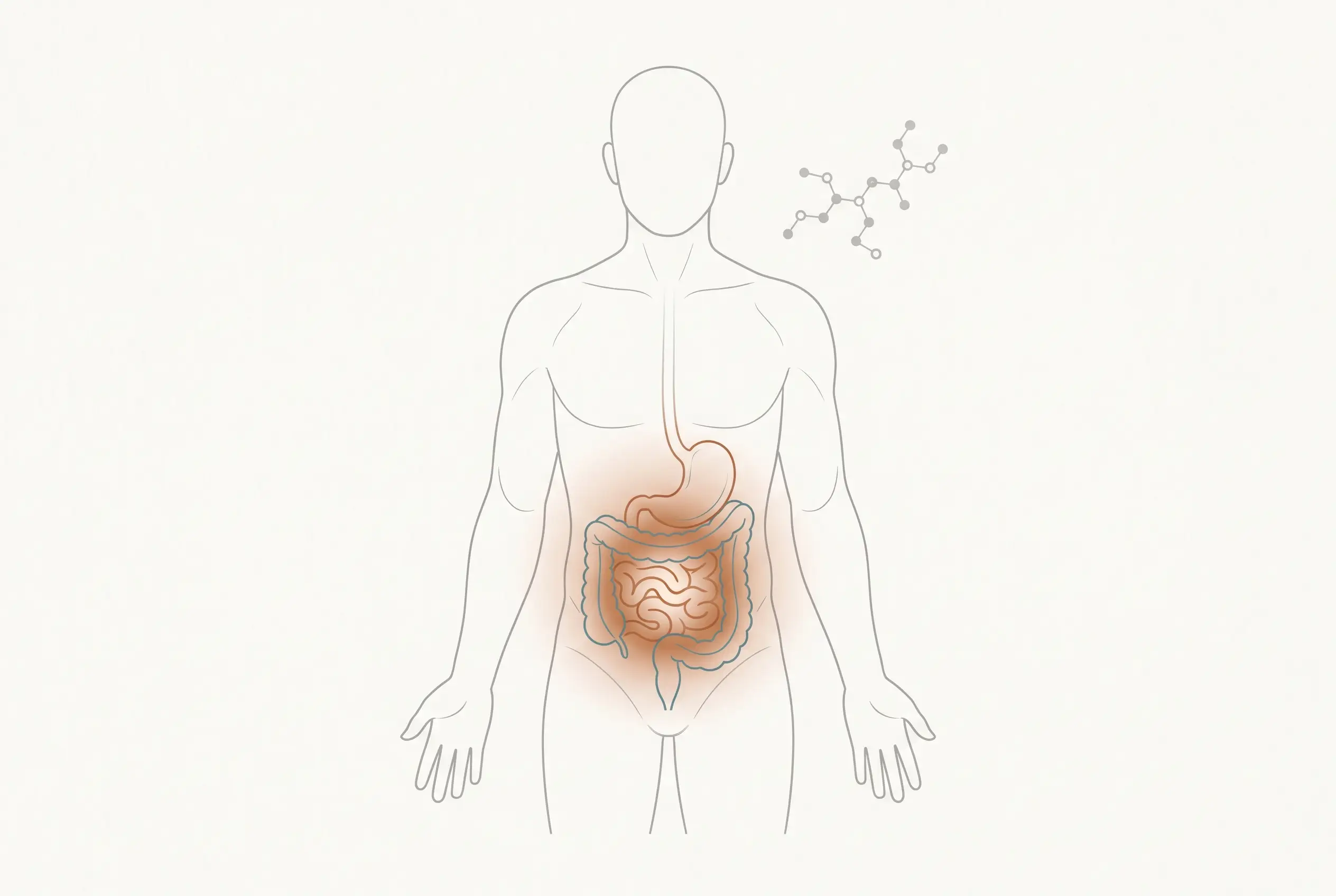
KPV comes up in talk about inflammation, gut health, and skin, usually with hopeful claims. Here's the honest picture: an interesting idea, some promising lab and animal research, very little human proof, and no approval as a medicine.
What KPV actually is
KPV is a very small man-made peptide, a chain of just three amino acids (the tiny building blocks that make up protein): lysine, proline, and valine, which is where the letters K, P, and V come from. It's a fragment (a small piece) of a natural body hormone called alpha-MSH, which is involved in things like inflammation and pigment. The version people talk about is made in a lab; it doesn't come ready-made from nature.
What it's studied for
In research (mostly in the lab and in animals), KPV has been looked at for:
- Calming inflammation in the body
- Gut inflammation, including conditions like inflammatory bowel disease (IBD)
- Immune modulation: gently dialing an over-active immune response up or down
On paper that sounds exciting. The catch is that most of it is in cells and animals, not people.
Does KPV work in humans?
Almost all the promising KPV results come from lab and animal studies. Preclinical results like these are a starting point, not proof. Plenty of things that look good in a dish or in mice never pan out in people. There are very few proper human studies of KPV, so we simply don't have solid evidence for how well it works, or how safe it is, in humans.
What makes KPV scientifically interesting is that it seems to keep the anti-inflammatory part of alpha-MSH without the part that affects skin pigment. A review of alpha-MSH-related peptides put it this way:
Interestingly KPV, C-terminal tripeptide of α-MSH, which lacks the entire sequence motif required for binding to any of the known MC-Rs, retains almost all of the anti-inflammatory capacity of the full hormone, but in its activities display a lack of any pigmentory action.
Advances in Experimental Medicine and Biology, 2010 (PMID 21222263)
That's a genuinely neat piece of biology. It's also a review of preclinical work. It explains why researchers keep looking at KPV, not that it treats anything in people.
Is KPV an approved medicine?
No. It isn't approved by the FDA or any other major regulator, so it can't legally be sold to treat anything. It's sold as a 'research chemical' instead, which is a legal category, not a safety rating.
What the research points to
- Interesting anti-inflammatory effects in lab and animal studies
- A reason scientists find alpha-MSH and its fragments worth studying further
- Early, unproven promise for gut inflammation and immune balance
What it does NOT prove
- That it safely treats inflammation or IBD in humans
- That it's safe to take: human safety isn't established
- That it's an approved or legal medical treatment
Who talks about it, and why to be careful
KPV is popular in biohacking, gut-health, and skincare circles, where people share "protocols" and "stacks." Remember that these are personal experiments with an unapproved chemical, not medical guidance. Big claims online are usually based on lab and animal studies plus anecdotes, not human proof. If you're dealing with a real gut or inflammatory condition, a qualified doctor is the right call.
What this does not mean
- This does not mean KPV is proven to work in humans. The promising results are in lab and animal research.
- This does not mean it's safe to buy and take; unregulated products aren't checked for purity or safety.
- This is general education, not medical advice or a recommendation to use KPV.