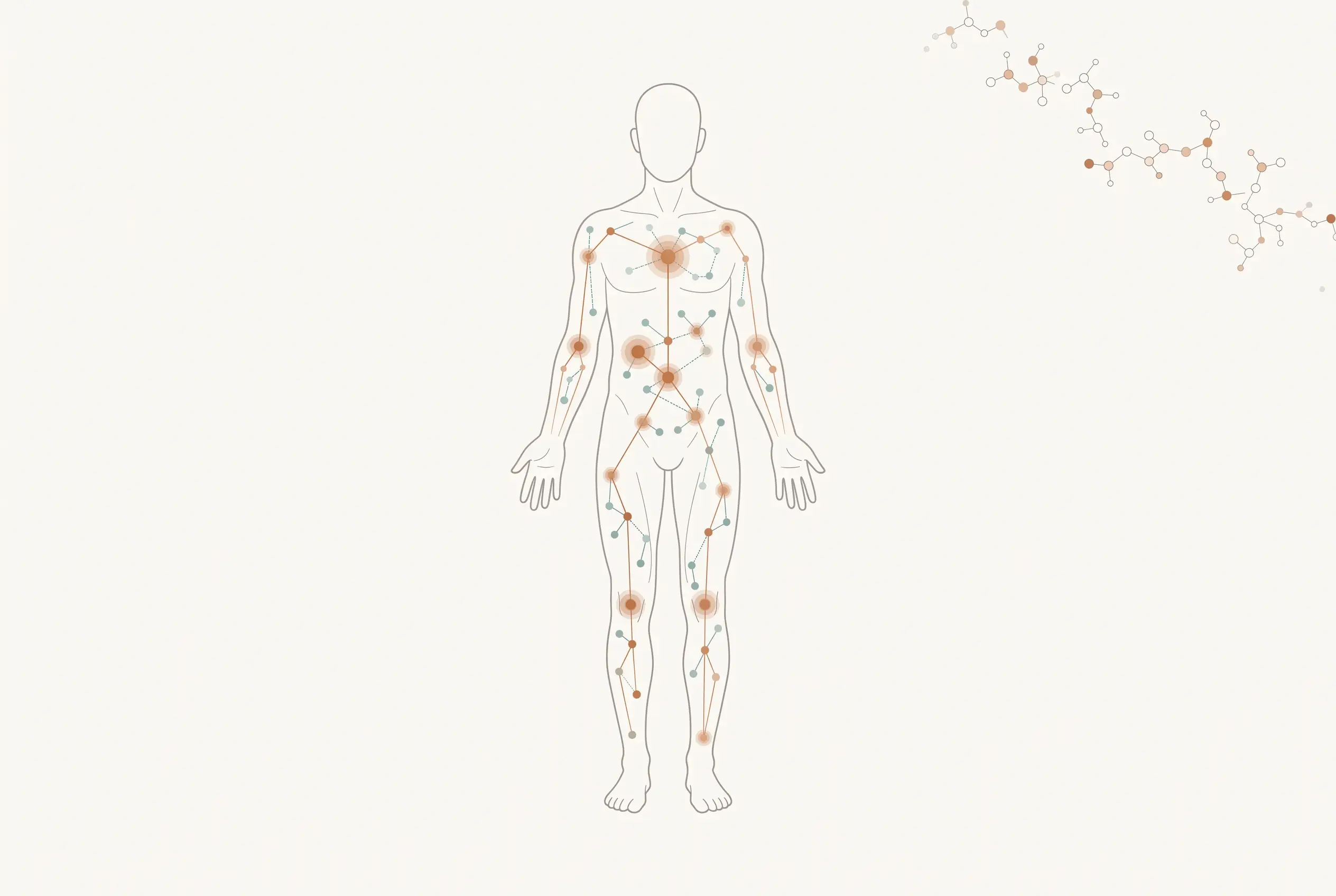
Humanin shows up in longevity and anti-ageing conversations as a peptide the body can make on its own. That's a genuinely interesting piece of biology. But interesting biology is not the same as a proven treatment. Here's the honest picture: a natural peptide, promising early lab work, very little human proof, and no approval as a medicine.
What Humanin actually is
Humanin is a small natural peptide: a short chain of amino acids (the tiny building blocks that make up protein). It's called a "mitochondrial-derived peptide," which means the body's cell batteries, the mitochondria, can make it. That puts it in the same family as another peptide called MOTS-C. The versions people talk about buying are made in a lab.
What it's studied for
In research (mostly in cells and animals), Humanin has been looked at for:
- Ageing and how cells cope with stress
- Protecting brain cells
- How the body handles energy and blood sugar
That's a big, exciting list. The important word is "studied," not "proven."
Does Humanin actually work in people?
Most of what we know about Humanin comes from lab dishes and animal studies. That kind of research is a starting point, not proof. Plenty of things that look good in a dish or in mice never work out in people. There's very little proper human research, so we can't say how well it works, or how safe it is, in humans.
The papers people cite are honest about what they found, and about how far it goes. One frequently referenced study on mitochondrial-derived peptides concluded:
These results suggest that mitochondria play critical roles in metabolism and survival through the synthesis of mitochondrial peptides, and provide new insights into mitochondrial biology with relevance to aging and human biology.
Aging (Albany NY), 2016 (PMID 27070352)
"New insights into mitochondrial biology" is a fair description. "A proven anti-ageing treatment" is not what that sentence says.
Is Humanin an approved medicine?
No. It isn't approved by any major regulator, so it can't legally be sold to treat anything. Products sold online under the name aren't quality-checked, which is a separate risk from the unanswered question of whether it does anything useful in humans.
What the research points to
- Interesting roles for a natural, body-made peptide in early studies
- A reason scientists find it worth studying for ageing and the brain
- Early, unproven promise seen mostly in cells and animals
What it does NOT prove
- That it slows ageing or protects the brain in humans
- That it's safe to inject: human safety isn't established
- That it's an approved or legal medical treatment
Who talks about it, and why to be careful
Humanin is popular in longevity and biohacking circles, often alongside other "cell-battery" peptides. Remember that these are personal experiments with an unapproved chemical, not medical guidance. Big anti-ageing claims online usually rest on lab and animal studies plus hope, not human proof. There's no shortcut here that a real, tested treatment has already been shown to be.
What this does not mean
- This does not mean Humanin is proven to slow ageing or protect the brain in humans. The strong results are in cells and animals.
- This does not mean it's safe to buy and inject; unregulated products aren't checked for purity or safety.
- This is general education, not medical advice or a recommendation to use Humanin.