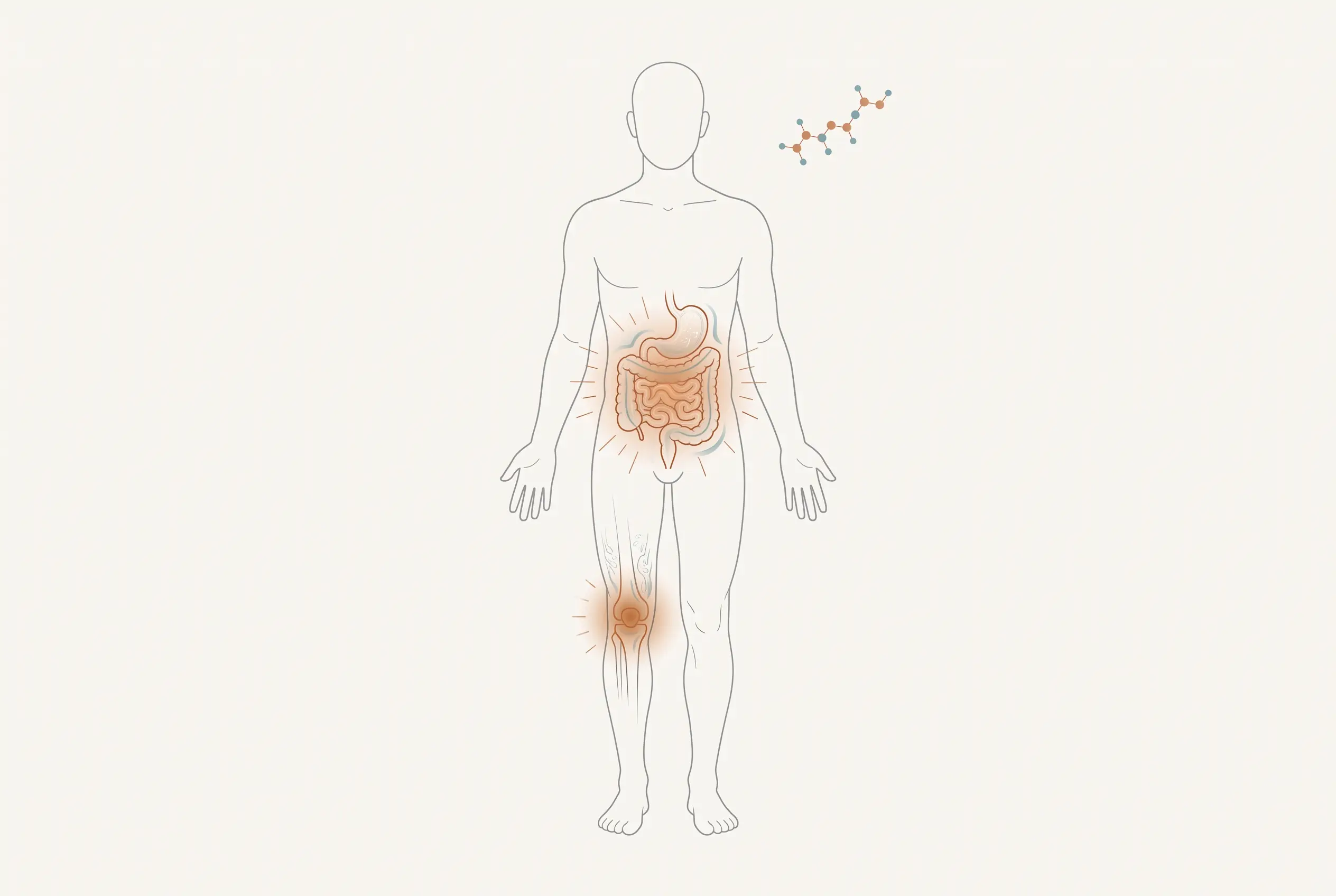
ARA-290 sits in an unusual spot. Most peptides you find for sale online have never been near a proper human trial. ARA-290 has: several of them, published in real journals, with placebo groups. That makes it more interesting than most. It also makes it easy to oversell. Here's the honest picture: a clever idea, some genuinely encouraging human results, and a development program that quietly stalled without ever reaching approval.
What ARA-290 actually is
ARA-290 is a man-made peptide: a short chain of amino acids (the tiny building blocks that make up protein). It's an 11-amino-acid copy of one small section of erythropoietin (EPO), a hormone your body produces naturally. You may know EPO as the drug cyclists got caught doping with, because it boosts red blood cells and therefore endurance.
EPO turns out to do two quite separate jobs. One is making red blood cells. The other is protecting tissue and calming inflammation. Scientists worked out that these two jobs run through different receptors (think of a receptor as a lock on the outside of a cell that only certain keys fit). So they built ARA-290 as a key that fits only the tissue-protection lock and not the red-blood-cell one. That's the whole point of the molecule: EPO's repair effects without thickening your blood.
It's also known as cibinetide, which is the formal drug name it was given when it went into clinical trials. Same substance.
What it's studied for
The main focus has been small-fibre neuropathy: damage to the tiny nerve endings in your skin that sense temperature and pain. When they're damaged, people get burning, stabbing, or electric-shock sensations, often in the hands and feet. It's miserable and hard to treat.
Specifically, ARA-290 has been tested in people who have this nerve damage as a complication of sarcoidosis (an inflammatory disease that causes small clumps of immune cells to build up in the lungs and other organs). Researchers have also looked at it in:
- Diabetes and prediabetes: whether it affects blood sugar control
- Diabetic macular oedema: swelling at the back of the eye caused by diabetes
- How healthy volunteers process emotions (a small brain-imaging study)
- Animal work on stroke, colitis, lupus, heart ageing, and islet transplants
What the evidence really shows
This is where ARA-290 genuinely differs from something like TB-500. There are real, published, placebo-controlled human trials, and some of them found real effects.
A 2012 pilot study in 22 sarcoidosis patients found ARA-290 improved neuropathy symptom scores compared to placebo, with no safety red flags. A 2013 trial found it improved neuropathic symptoms and, strikingly, actually increased the density of nerve fibres in the cornea, which doctors can measure directly with a microscope. That matters, because it suggests the drug wasn't just dulling pain but possibly repairing nerves. A larger 2017 trial in 64 patients backed this up: the 4 mg group showed a significant increase in corneal nerve fibre area.
So why isn't this a medicine you can get?
| The encouraging part | The catch |
|---|---|
| Placebo-controlled human trials exist | They're small: 22, 24, and 64 people. Real drugs need hundreds to thousands. |
| Results were statistically significant | Mostly on surrogate markers (nerve fibre density), not on how patients actually felt long-term |
| Published in peer-reviewed journals | Nearly all were run or funded by Araim Pharmaceuticals, the company that owns the molecule |
| Trials began back in 2012 | No phase 3 trial was ever completed. The eye trial was terminated after enrolling just 9 people. |
| No major safety alarms reported | Short trials (28 days). Long-term safety in humans is simply unknown. |
The pattern here is important to understand. A drug with genuinely strong mid-stage results normally attracts investment and moves to large phase 3 trials. ARA-290 has been in trials since 2012 and never got there. That doesn't prove it doesn't work. Funding dries up for lots of reasons, and rare diseases like sarcoidosis are commercially unattractive. But more than a decade of not progressing is information, and you should weigh it.
What the research points to
- Genuine placebo-controlled human trials exist, rare for a 'research chemical'
- Small trials suggested improved nerve-pain symptoms in sarcoidosis patients
- Measured increases in corneal nerve fibre density: an objective, visible marker
- A sound scientific rationale: separating EPO's repair effects from its blood effects
What it does NOT prove
- That it's approved, or proven effective, for anything: no regulator has cleared it
- That the results hold up at scale: no phase 3 trial was ever completed
- That it's safe long-term: the human trials ran about 28 days
- That a vial bought online resembles the tested product in purity or dose
Who talks about it, and why to be careful
ARA-290 gets discussed in biohacking and chronic-pain forums, and vendors lean hard on the phrase "clinically studied", which is technically true and deeply misleading. "Clinically studied" and "clinically proven" are not the same sentence. Plenty of drugs with promising phase 2 results go on to fail phase 3 completely; that's roughly why phase 3 exists.
There's a second thing worth flagging. The people in those trials had a specific, diagnosed condition: nerve damage from sarcoidosis. Results in that group tell you very little about what the peptide would do in a healthy person, or in someone with nerve pain from a different cause. If you're living with neuropathy, that's genuinely worth taking to a neurologist, who has approved options and can find out what's actually causing it.
What this does not mean
- This does not mean ARA-290 is approved: 'has been in clinical trials' and 'is an approved medicine' are very different things.
- This does not mean the promising early results are confirmed; the trials were small and never advanced to a completed phase 3.
- This does not mean a product bought online matches what was tested. Unregulated vials aren't checked for purity, sterility, or dose.
- This is general education, not medical advice or a recommendation to use ARA-290.