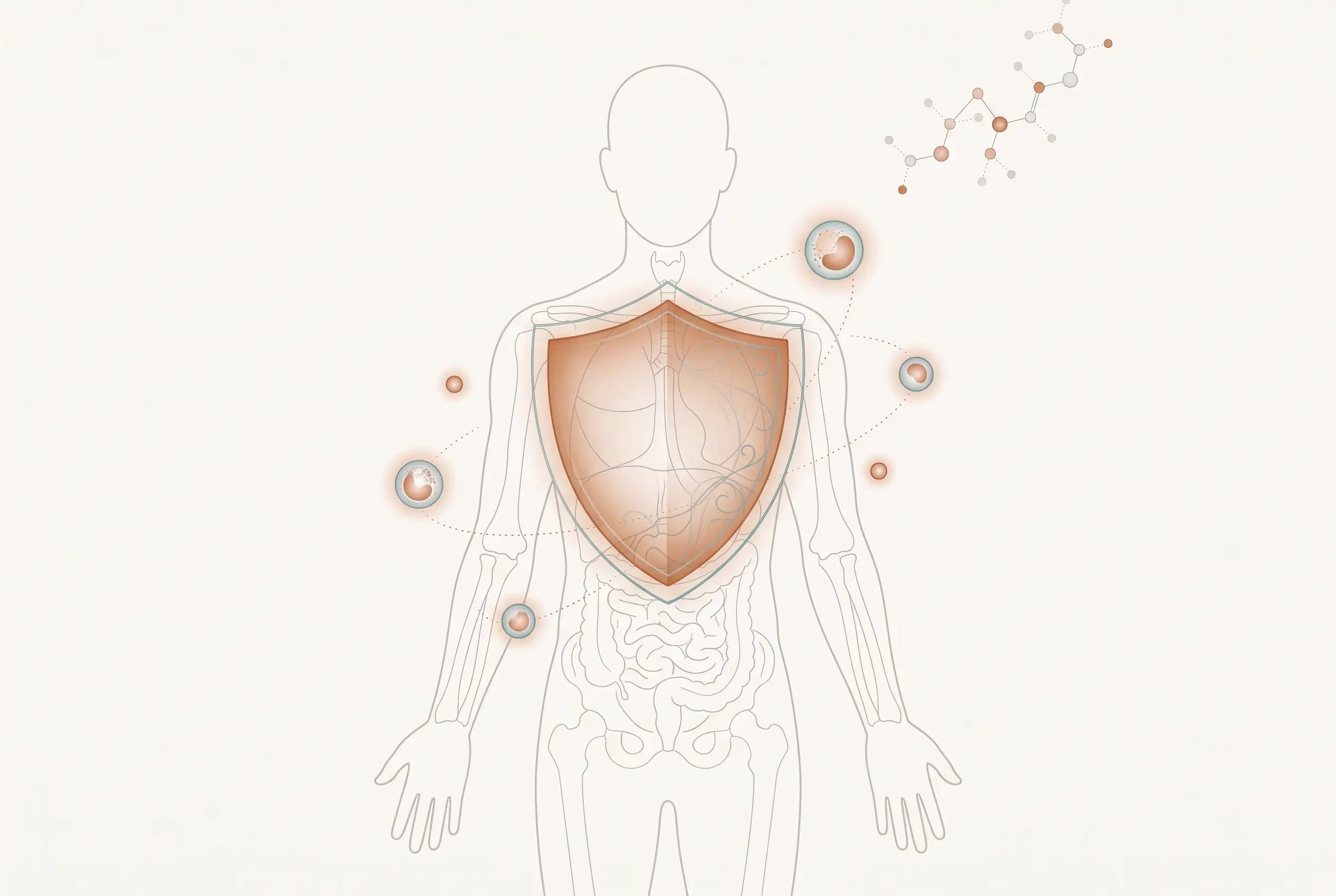
If you've searched Thymalin, you've probably found two kinds of pages: shops selling it, and blogs promising it will rebuild your immune system. Here's the honest middle: it's a real preparation with a real history, it's genuinely used as a medicine in Russia, and the evidence behind it is much thinner and much less independent than the marketing suggests.
What Thymalin actually is
Thymalin is an extract from the thymus gland of calves. The thymus is a small gland behind your breastbone that trains the immune cells (T-cells) that fight infection. It shrinks as you get older, which is part of why immunity fades with age, and that's the whole idea behind Thymalin.
Importantly, Thymalin is not a single molecule. It's a mixture of peptides pulled out of thymus tissue, so what's in the vial can vary depending on who made it and how. That's very different from a drug like insulin, where every dose is the same defined molecule. Researchers have since identified two short peptides inside it, called KE (Lys-Glu) and EW (Glu-Trp), that they believe do much of the work.
Where it comes from: the Khavinson story
Thymalin comes from the work of Vladimir Khavinson and the St Petersburg Institute of Bioregulation and Gerontology, starting in the 1970s. His team developed a family of what they call "peptide bioregulators" (Thymalin, Epitalon, Vilon, Cortexin and others), each extracted from a different organ, each claimed to help that same organ work properly again.
This matters for reading the evidence. A large share of the published Thymalin research is authored by Khavinson or his institute. That doesn't make it fraudulent, and the lab is a real scientific institution. But in science, the strongest signal is when independent groups with no stake in the result repeat a finding and get the same answer. For Thymalin, that has mostly not happened.
What it's studied for
- Immune function, especially the age-related decline in T-cells
- Inflammation, including work on severe COVID-19 in older patients
- General ageing and 'geroprotection' (slowing age-related decline)
- Blood clotting and vascular markers in elderly patients
What the evidence really shows
Split the research into two piles and it gets much clearer.
Pile one: lab-dish studies. These are the bulk of it. Thymalin and its KE/EW peptides have been shown to lower inflammatory signals in human immune cells grown in a dish, and to nudge genes involved in inflammation. This is real work, and it's a legitimate reason to keep studying the stuff. But cells in a dish are not a person. Countless things calm inflammation in a dish and do nothing useful in a human body.
Pile two: human studies. These exist (including a study adding Thymalin to standard COVID-19 care), but they are small, mostly Russian, and largely from the originating lab or its collaborators. They generally aren't the kind of large, independent, randomised, placebo-controlled trials that Western regulators require before calling something proven.
| What people claim | What's actually behind it |
|---|---|
| "Restores your immune system" | Cell-dish studies plus small Russian trials, no large independent human proof |
| "Proven for COVID" | One small add-on study from the originating lab; not replicated independently |
| "Clinically used, so it's validated" | Registered in Russia, but Russian registration is not FDA/EMA approval |
| "Anti-ageing breakthrough" | No human trial has shown Thymalin extends life or slows ageing |
What the research points to
- Anti-inflammatory effects on human immune cells in lab dishes
- A plausible biological idea: the thymus really does shrink with age
- Decades of Russian clinical use, and small studies suggesting benefit
What it does NOT prove
- That it rebuilds your immune system or slows ageing in humans
- That it's safe: human safety isn't established to Western standards
- That it's approved or legal as a medicine in the US, UK, or EU
- That the findings hold up independently: they've rarely been tested outside the originating lab
The honest bottom line
Thymalin isn't snake oil, and it isn't a proven anti-ageing drug either. It's a decades-old preparation with a real research programme behind it that never cleared the bar Western medicine sets, not because anyone proved it doesn't work, but because the large, independent human trials that would settle it simply haven't been done. If someone selling it tells you the science is settled, they're describing marketing, not evidence.
What this does not mean
- This does not mean Thymalin is proven to boost immunity or slow ageing in humans. The strong results are in lab dishes, and the human studies are small and rarely independent.
- This does not mean Russian registration equals FDA or EMA approval. Those regulators have not evaluated it.
- This does not mean it's safe to buy and inject; unregulated animal-tissue products aren't checked for purity, sterility, or safety.
- This is general education, not medical advice or a recommendation to use Thymalin.