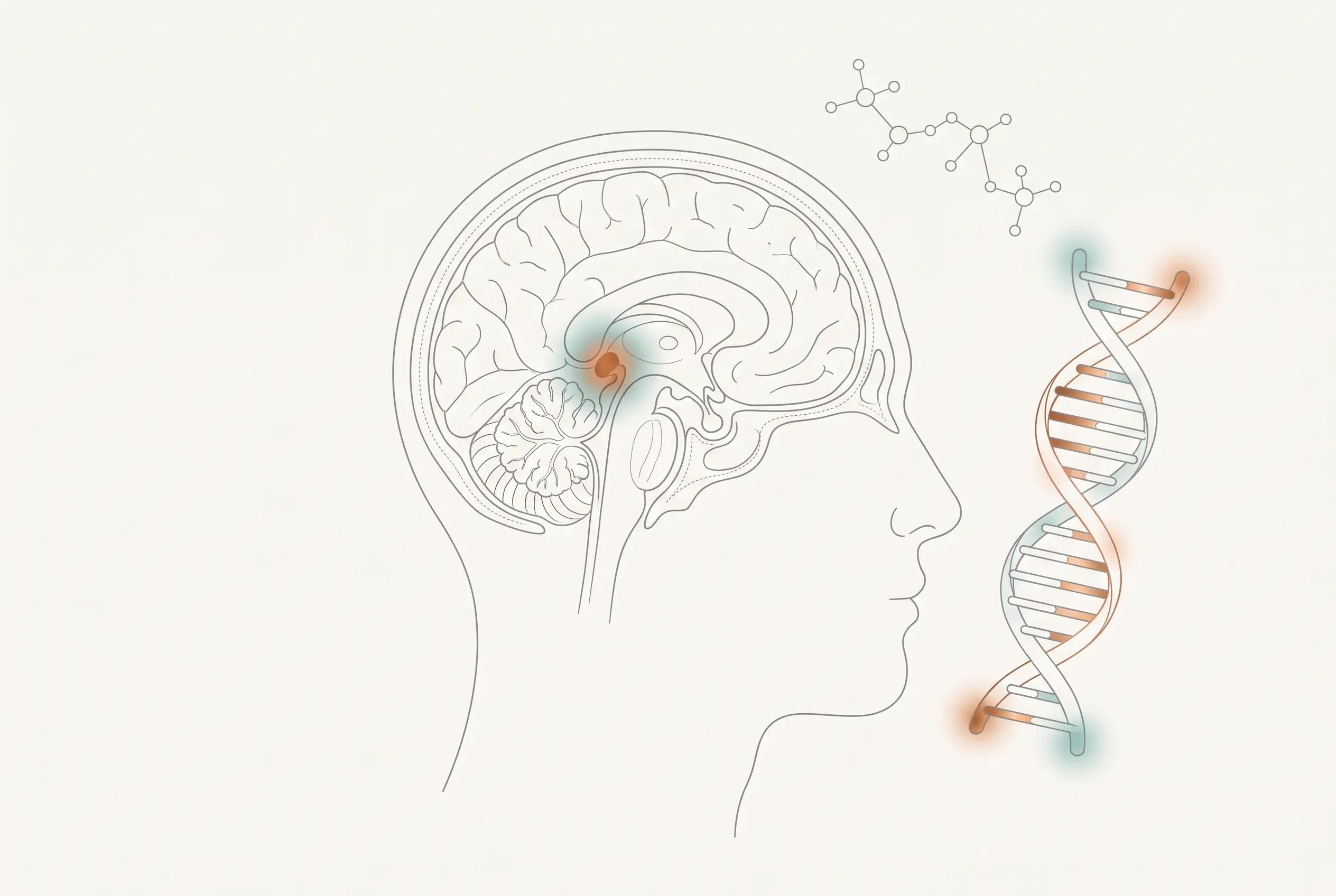
Pinealon gets marketed as a brain-repair peptide: sharper memory, protected neurons, slower brain ageing. The underlying research is more modest than that, and considerably more lopsided. Here's what's actually there.
What Pinealon actually is
Pinealon is a tripeptide: a chain of exactly three amino acids. The three are glutamic acid, aspartic acid and arginine, which is why researchers write it as EDR or Glu-Asp-Arg. If you go looking for studies, search EDR rather than Pinealon: the brand name barely appears in the scientific literature, but the peptide itself does.
It's named after the pineal gland, a tiny gland deep in the brain that produces melatonin and helps run your sleep-wake cycle. Like the rest of the Khavinson peptide family, it came out of the St Petersburg Institute of Bioregulation and Gerontology, built on the theory that a short peptide derived from an organ can help that organ work properly again. Pinealon is the brain one; Epitalon is its better-known sibling from the same gland.
What it's studied for
- Memory and cognitive function, particularly in older people
- Protecting neurons from damage and from oxidative stress (a kind of chemical wear-and-tear inside cells)
- Alzheimer's-related biology, including the loss of dendritic spines (tiny knobs on neurons where connections form)
- General brain ageing and 'geroprotection'
What the evidence really shows
The EDR research falls into three tiers, and the quality drops off sharply as you move toward anything resembling proof.
Tier one: lab and animal work. This is the bulk of it. EDR has been studied in cultured neurons, in mouse models of Alzheimer's and Huntington's disease, and in rat cerebellum cells, where it's been linked to reduced cell death and increased antioxidant enzymes. There's also physical-chemistry work showing EDR can actually slot into the groove of a DNA molecule, which is at least a concrete mechanism rather than hand-waving.
Tier two: very small Russian human studies. A handful exist. One followed 32 patients with chronic illness and brain injury; another compared geroprotective methods in 110 people. Both are Russian-language, both are small, and neither is the kind of randomised, placebo-controlled, independently-run trial that would settle anything. Notably, in one of those studies Pinealon performed worse than the comparison peptide it was tested against, a detail you will not find on any vendor's website.
Tier three: independent Western confirmation. This tier is essentially empty. A 2026 review of therapeutic peptides in orthopaedics, written by US authors, name-checks Pinealon alongside Epitalon and others and reaches a blunt conclusion: the preclinical work is promising, but there is a current lack of clinical trials. That's the fair summary.
| Tier of evidence | What exists for Pinealon |
|---|---|
| Cells and animals | A reasonable amount: reduced cell death, antioxidant effects, DNA-binding work |
| Small human studies | A few, all Russian, all small, mostly from the originating lab |
| Large randomised human trials | None |
| Independent replication | Essentially none |
What the research points to
- Neuroprotective effects in cultured cells and in animal models of brain disease
- A concrete, physically-demonstrated mechanism (the peptide can interact with DNA)
- Early, unproven signals in a few very small Russian human studies
What it does NOT prove
- That it improves memory or protects the brain in humans: this is essentially untested
- That it helps with Alzheimer's or dementia: animal models are not people, and most Alzheimer's drugs that worked in mice failed in humans
- That it's safe to use: human safety isn't established
- That it's an approved or legal medical treatment
The honest bottom line
Pinealon has more of a mechanistic story behind it than most things sold in this corner of the internet, and the animal work isn't nothing. But the leap from "protects rat neurons in a dish" to "protects your brain" is the exact leap that has killed hundreds of far better-funded drug candidates. Nobody has done the trial that would tell us, and the compound has been around long enough that this absence is worth noticing.
What this does not mean
- This does not mean Pinealon is proven to improve memory or protect the brain in humans. The strong results are in cells and animals.
- This does not mean the animal Alzheimer's findings will translate. The history of Alzheimer's research is full of drugs that cured mice and did nothing for people.
- This does not mean it's safe to buy and use; unregulated products aren't checked for purity or safety.
- This is general education, not medical advice or a recommendation to use Pinealon.