You searched a peptide encyclopedia for orforglipron. So let's start with the honest answer, which is also the whole reason this page exists: orforglipron is not a peptide. It never was. And that isn't a technicality. The difference is the single most interesting thing about this drug.
So what is it, if not a peptide?
A peptide is a short chain of amino acids: the same tiny building blocks your body uses to make protein. Semaglutide (Ozempic, Wegovy), tirzepatide (Mounjaro, Zepbound), and basically every other GLP-1 drug you've heard of are peptides. They're essentially lab-made versions of things your body already builds.
Orforglipron is a small molecule. That's a different category of chemical entirely: a compact, sturdy structure built by chemists from scratch, not assembled from amino acids. Aspirin is a small molecule. So is ibuprofen. So is almost every pill in your medicine cabinet.
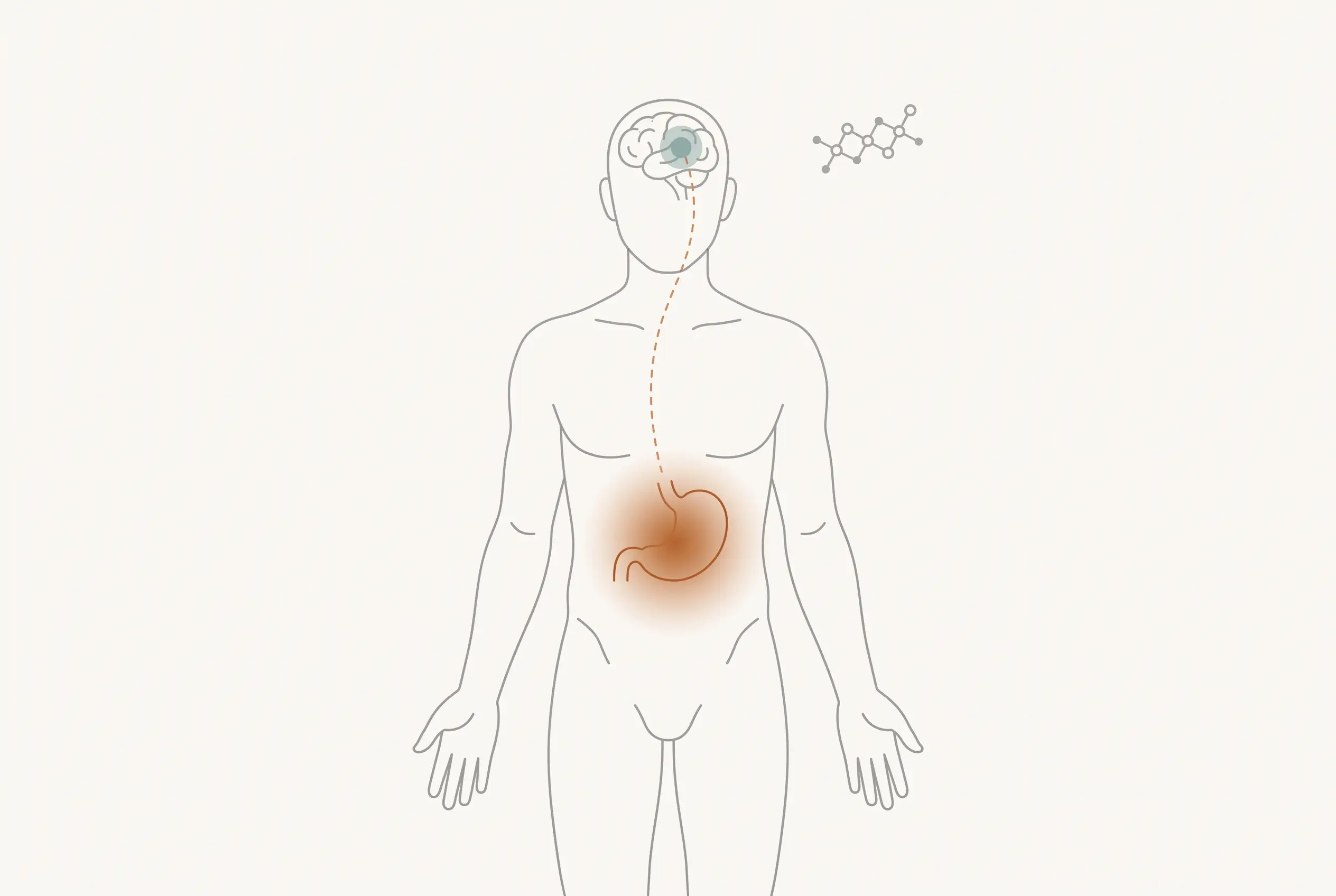
Both orforglipron and semaglutide press the same button: the GLP-1 receptor. GLP-1 is a hormone your gut releases after you eat; it's the 'I'm full' signal that curbs appetite and slows how fast food leaves your stomach. A receptor is the lock, and both drugs are keys that fit it. But one key is carved from protein and the other from chemistry. Same lock, completely different key.
Why the difference actually matters to you
This isn't chemistry trivia. Being a small molecule changes three real-world things:
| Peptide GLP-1s (semaglutide, tirzepatide) | Orforglipron (small molecule) | |
|---|---|---|
| Can it be a pill? | Barely. Peptides get digested like food: your stomach breaks them apart. Oral versions need special tricks and most of the drug is still lost. | Yes, straightforwardly. Small molecules survive the stomach and absorb well. That's the headline feature. |
| Does it need a fridge? | Generally yes: a 'cold chain' of refrigerated shipping and storage all the way to you. | No. Sturdy chemicals sit on a shelf, which matters enormously for cost and for reaching hot countries. |
| How is it made? | Biotech manufacturing: complex, slow, expensive, hard to scale. A big reason for shortages. | Standard chemical synthesis, like most pills. Cheaper and far easier to scale up. |
That last row is the quiet one, but it may end up mattering most. Peptide drugs are hard to manufacture, which is a real part of why they've been expensive and periodically in short supply. A pill made by ordinary chemistry sidesteps that whole problem. Whether that translates into lower prices for actual patients is a separate question (one about pricing decisions, not chemistry), and it isn't settled.
Is orforglipron approved? Yes, and this part surprised a lot of people
The FDA approved orforglipron on 1 April 2026, under the brand name Foundayo. It's approved for long-term weight management in adults with obesity, or adults with overweight plus at least one weight-related health condition, alongside a reduced-calorie diet and more physical activity.
It's worth knowing how it was approved, because it was unusual. It went through the FDA's new Commissioner's National Priority Voucher programme, a pilot scheme that compresses the review from the normal several months down to roughly one or two. Orforglipron was the first brand-new drug ever approved through it, reportedly the fastest approval of a new molecular entity since 2002.
That's a real approval by a real regulator, based on real Phase 3 data. It is not a loophole. But a much faster review does mean less time spent poring over the file, and it's reasonable to hold that in mind rather than pretend the speed was irrelevant.
Does orforglipron actually work?
The evidence here is genuinely strong: among the strongest of anything covered on this site. Orforglipron has multiple completed Phase 3 trials, the big final stage of testing, published in the New England Journal of Medicine and The Lancet.
| Trial | What it tested | What it found |
|---|---|---|
| ATTAIN-1 (Phase 3, NEJM 2025) | 3,127 adults with obesity but not diabetes, over 72 weeks, against a placebo (a dummy pill) | Clear weight loss versus placebo, with more at higher doses. At the highest dose tested, most participants lost at least 10% of their body weight, and roughly a third lost at least 15%. |
| ATTAIN-2 (Phase 3, Lancet 2025) | 1,613 adults with obesity or overweight AND type 2 diabetes, over 72 weeks, against placebo | Weight loss again clearly beat placebo, and blood sugar and other heart-related measures improved too. |
| ACHIEVE-1 (Phase 3, NEJM 2025) | 559 adults with early type 2 diabetes, over 40 weeks, against placebo | Meaningfully lowered long-term blood sugar (HbA1c), plus some weight loss. |
| ACHIEVE-3 (Phase 3, completed) | 1,698 adults with type 2 diabetes, head-to-head against oral semaglutide | Reported as favouring orforglipron on both blood sugar and weight, a rare direct comparison rather than a cross-trial guess. |
| Ongoing | Heart and kidney outcomes, sleep apnea, osteoarthritis, adolescents, and more | Not finished |
Two honest limitations. First, the long-term picture is thin. These trials ran 40 to 72 weeks. Obesity is managed over decades, and a large trial checking whether orforglipron actually prevents heart attacks and strokes is still running. That answer is years away. Second, every trial so far was funded by the manufacturer. That doesn't make the results false, and the journals involved are demanding. It's just a bias worth naming out loud.
And the side effects are not a footnote. Gut problems (nausea, vomiting, diarrhoea, constipation) were common, and were the main reason people quit. They were worst while the dose was being worked up. This is the same tax the whole GLP-1 class charges. Trials also noted a rise in heart rate, and a small number of mild pancreatitis cases.
In adults with obesity, 72-week treatment with orforglipron led to significantly greater reductions in body weight than placebo; the adverse-event profile was consistent with that of other GLP-1 receptor agonists.
New England Journal of Medicine, 2025 (PMID 40960239)
What the evidence supports
- A genuine FDA approval, in April 2026, based on completed Phase 3 trials
- Substantial weight loss versus placebo across large, long, well-published trials
- Improved blood sugar in type 2 diabetes, including in a head-to-head against oral semaglutide
- A real practical advantage: an effective GLP-1 you swallow, with no fridge and no food-timing rules
What it does NOT prove
- That it's a peptide: it isn't, and that's the whole point of this page
- That its long-term safety is settled; the longest trials ran about 72 weeks
- That it prevents heart attacks or strokes: that trial is running and won't report for years
- That it beats the injectables on weight loss; the peptide injectables generally still post higher numbers
- That anything sold online under this name is the approved medicine
The simple version
Orforglipron is an approved, real, prescription weight-management medicine that presses the same button as Ozempic, but it is not a peptide, and that's why it's a tablet instead of an injection. If you're actually considering it, that conversation belongs with a doctor, partly because the label carries a boxed warning that someone needs to check against your history. And if you're looking at it on a peptide-seller's website, you've found a counterfeit, because that is not where this drug comes from.
What this does not mean
- This does not mean orforglipron is a peptide: it's a small molecule, and lumping it in with peptide GLP-1 drugs is the single most common error made about it.
- This does not mean 'approved' makes online sellers safe; an approved, in-demand drug attracts more counterfeits, not fewer. Anything sold as injectable 'research' orforglipron is a red flag on its face.
- This does not mean it's proven safe long-term: the published trials ran roughly 40 to 72 weeks, and the heart-outcomes trial hasn't reported.
- This does not mean it beats the injectable GLP-1 drugs on weight loss; on the numbers so far, it generally doesn't.
- This does not mean being a pill makes it gentle: gut side effects were common and were the main reason people stopped taking it.
- This is general education, not medical advice or a recommendation to use orforglipron.