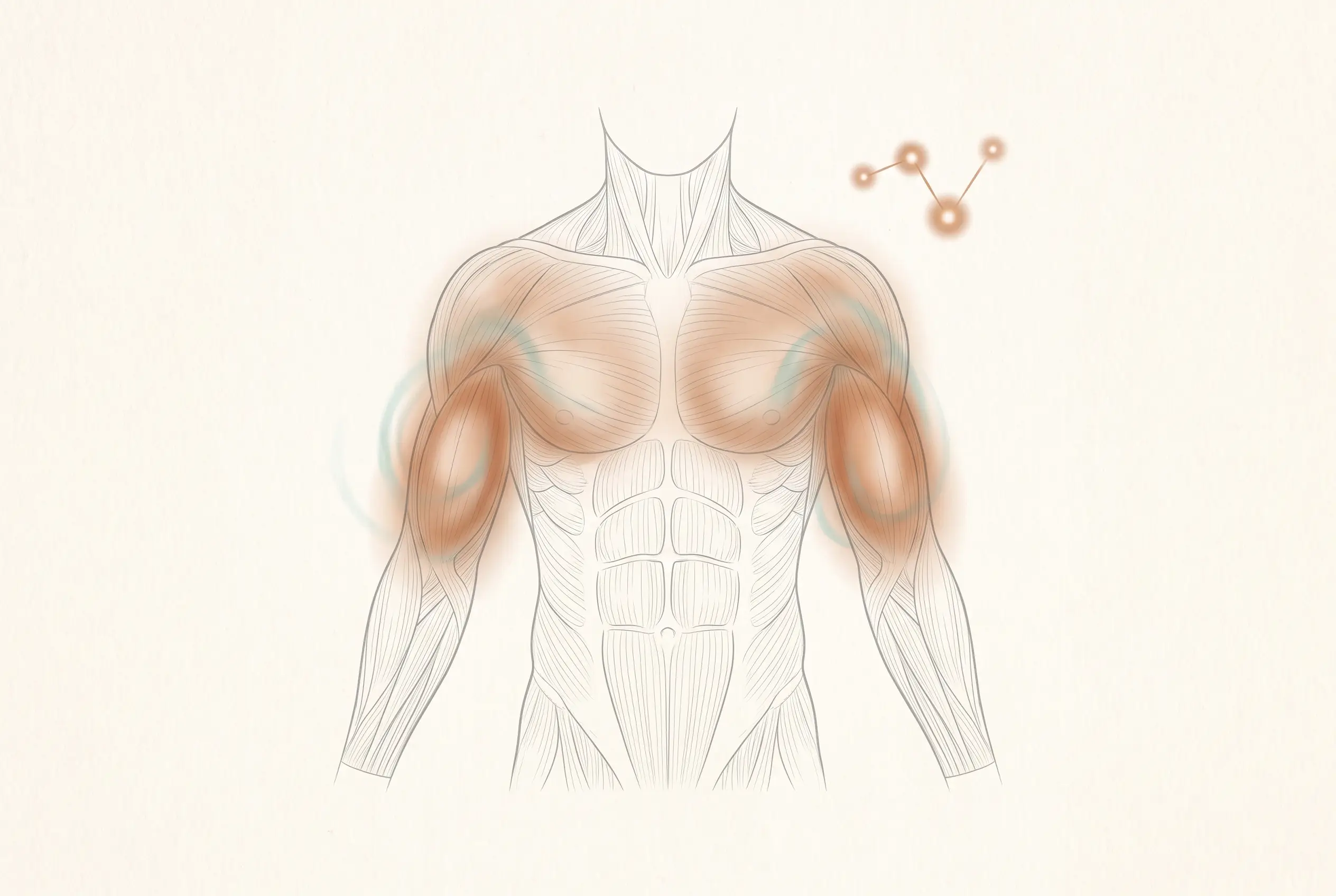
IGF-1 LR3 shows up in hardcore bodybuilding talk as a powerful muscle-building signal. Here's the honest picture: it's based on a real, powerful body chemical, it's not approved for the way people use it, and it carries genuine risks that make it different from the 'gentler' peptides.
What IGF-1 LR3 actually is
First, the natural version: IGF-1 stands for insulin-like growth factor 1. It's a signal your body makes (largely in response to growth hormone) that tells cells to grow and repair. It's a big part of how the body builds muscle and other tissue.
IGF-1 LR3 (short for 'Long R3 IGF-1') is a modified, lab-made version of that natural signal. The changes make it last much longer in the body than natural IGF-1, so its growth signal keeps firing for a longer stretch. It's an anabolic signal, which just means 'tissue-building.'
What is IGF-1 LR3 used for?
IGF-1 and versions like LR3 are studied in the lab for:
- Muscle growth
- General cell growth and repair
Some bodybuilders use IGF-1 LR3 to try to grow muscle. That's an off-label, unapproved use, not something backed by approval or by solid human safety data.
Is IGF-1 LR3 safe to use?
IGF-1 is genuinely a powerful growth signal, so it's not surprising people are interested. But a strong growth signal cuts both ways, and IGF-1 LR3 carries real, specific risks:
- It can act a bit like insulin and lower blood sugar, which can be dangerous (low blood sugar can cause shakiness, confusion, or worse).
- It's a growth signal that tells cells to multiply, and telling cells to grow in an uncontrolled way is a real safety concern.
There isn't solid human data showing it's safe to use this way, and the risks above are not minor. This is one where 'research chemical' really means 'nobody has established this is safe for you.'
Does IGF-1 LR3 actually build muscle?
The honest answer is that nobody has shown that in people. "Long R3 IGF-1" is the full name, and it's an anabolic (tissue-building) signal on paper, but even in animals, the growth it produces isn't the tidy muscle gain the marketing implies. One of the older animal studies found it grew organs rather than the animal:
However, the fractional weight of adrenals, gut, kidneys and spleen were significantly increased by LR3IGF-I, but again overall growth was not stimulated.
Journal of Endocrinology, 1995 (PMID 7561636)
Adrenals, gut, kidneys and spleen getting bigger while overall growth doesn't budge is not what anyone buying this is hoping for. It's a good reminder that "powerful growth signal" and "builds the tissue you want" are two very different claims.
What the research points to
- IGF-1 is a real, powerful growth and muscle-building signal
- A reason scientists study IGF-1 biology closely
- Early, lab-level interest in muscle and cell growth
What it does NOT prove
- That IGF-1 LR3 is safe to use for muscle-building
- That it's the same as the approved IGF-1 medicine (mecasermin): it isn't
- That it's an approved or legal treatment for building muscle
Who talks about it, and why to be careful
IGF-1 LR3 is discussed in serious bodybuilding circles, often with talk of 'cycles' and 'stacks.' Those are risky personal experiments with an unapproved chemical, not medical guidance. Given the blood-sugar and uncontrolled-growth risks, this is one to be especially cautious about. A qualified doctor is the right person to talk to about muscle, hormones, or health.
What this does not mean
- This does not mean IGF-1 LR3 is proven safe or approved for building muscle. It isn't.
- This does not mean it's the same as the approved IGF-1 medicine (mecasermin); it is not.
- This is general education, not medical advice or a recommendation to use IGF-1 LR3.