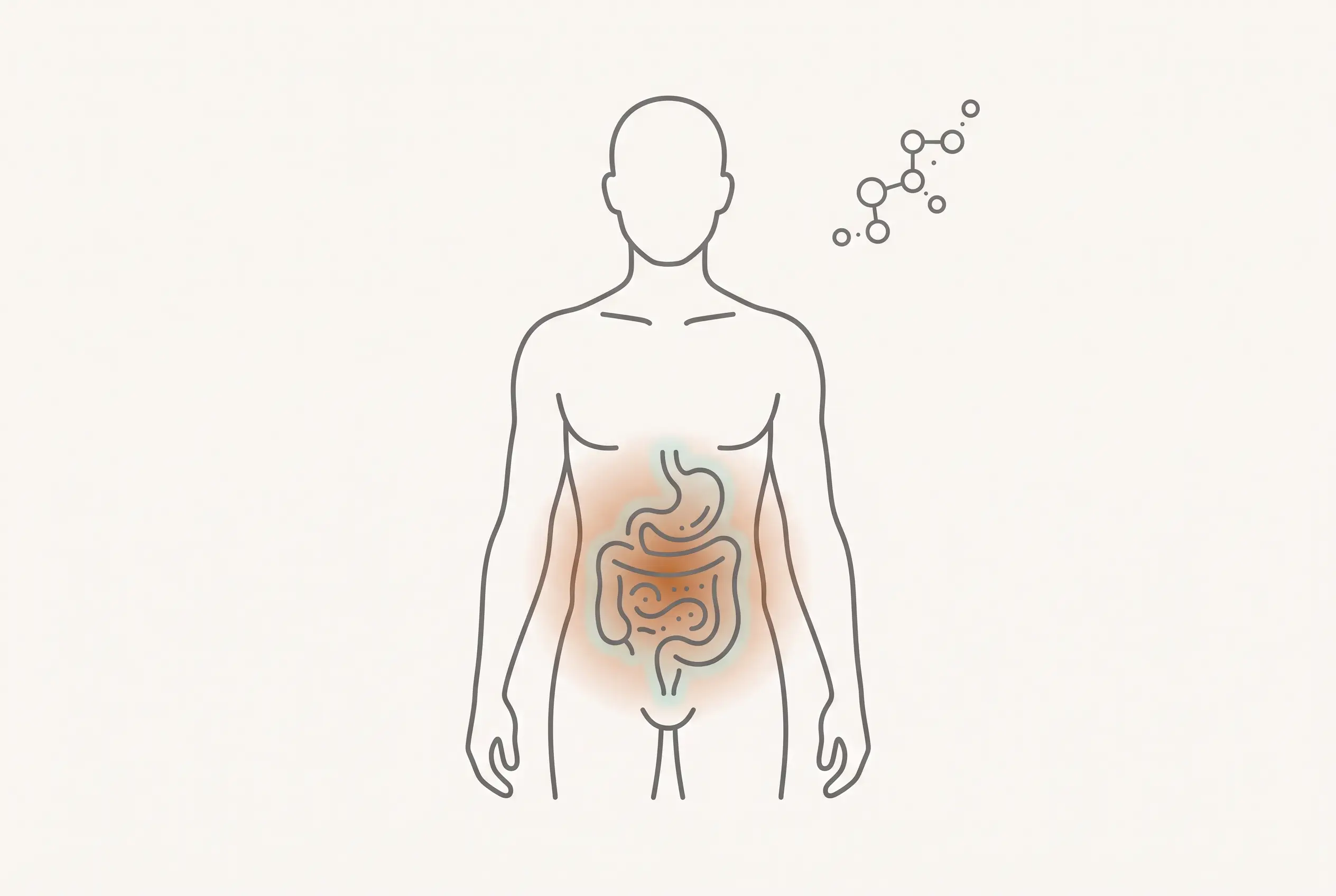
People often search for 'efinopegdutide phase 3'. That search doesn't mean a Phase 3 trial exists. We checked the trial registry, Merck's own pages, and the medical literature on 15 September 2026. The short version: efinopegdutide is still a Phase 2 drug. It is aimed mainly at your liver, not your waistline, and it is not approved anywhere we could find.
Is efinopegdutide in Phase 3? The current status
No. Here is what each official source said when we checked:
- ClinicalTrials.gov (US registry, checked 15 September 2026): 15 trial records under the names efinopegdutide, MK-6024, HM12525A and JNJ-64565111. Every one is Phase 1 or Phase 2. A search limited to Phase 3 returned zero trials.
- Merck's product pipeline (page dated 5 August 2026, checked 15 September 2026): efinopegdutide (MK-6024) is listed in Phase 2 for metabolic dysfunction-associated steatohepatitis (MASH), developed under an agreement with Hanmi Pharmaceutical.
- Merck's trial page for NCT05877547 (checked 15 September 2026): Phase 2, completed on 29 December 2025. No results are shown.
- PubMed (checked 15 September 2026): we found no published results from the Phase 2b trial and no paper describing a Phase 3 trial.
In June 2023, Merck said the US Food and Drug Administration (FDA) had given efinopegdutide Fast Track designation for NASH. Fast Track is a process meant to speed up development and review of drugs for serious conditions. It is not an approval, and it doesn't mean a drug has reached Phase 3.
What efinopegdutide actually is
Efinopegdutide (lab code MK-6024, and before that HM12525A) is a peptide. That just means a short chain of amino acids, the tiny building blocks that make up protein. It's man-made, and it's designed to copy signals your body already uses.
Scientists call it a dual agonist. An agonist is something that switches a receptor on. Picture a key that fits a lock. Efinopegdutide fits two locks:
- GLP-1: the 'I'm full' signal. It's the same target as semaglutide (the drug in Ozempic and Wegovy). Switching it on curbs appetite and slows how fast food leaves your stomach.
- Glucagon: a signal that affects how your body burns energy, and that acts on the liver directly to burn fat and make less of it.
That glucagon half is the whole point here. The theory is that you can shrink liver fat two ways at once: indirectly, by helping someone lose weight, and directly, by telling the liver itself to burn fat rather than store it. That's why the drug's development has pointed at liver disease rather than the obesity market.
It was created by Hanmi Pharmaceutical, a South Korean company. It has had three names because it has had more than one developer. Janssen (part of Johnson & Johnson) tested it as JNJ-64565111 for obesity and type 2 diabetes. A Janssen trial protocol on ClinicalTrials.gov confirms this is the same molecule. In August 2020, Merck licensed it from Hanmi to develop for NASH. It now carries Merck's code, MK-6024.
What it's studied for
Efinopegdutide's current trials are about the liver:
- MASLD stands for metabolic dysfunction-associated steatotic liver disease. In plain English: fat building up in your liver when alcohol isn't the cause. Older papers call it NAFLD. It is very common and often silent.
- MASH stands for metabolic dysfunction-associated steatohepatitis, formerly called NASH. This is the more serious version: the fat inflames the liver and can scar it over time. Scarring is called fibrosis, and enough of it becomes cirrhosis, which is permanent damage.
- Obesity and type 2 diabetes were the focus of Janssen's earlier trials, which ended by 2019.
Every registered efinopegdutide trial
These rows come from the ClinicalTrials.gov record for each trial, checked on 15 September 2026. 'Completed' means the trial finished. It does not mean it succeeded. Dates are the registry's own dates.
Merck trials (code MK-6024)
| Trial (NCT) | Phase | Population | Enrollment | Status | Primary endpoint | Key dates |
|---|---|---|---|---|---|---|
| NCT05877547 (MK-6024-013) | Phase 2b | Adults with biopsy-confirmed NASH and moderate or advanced scarring (fibrosis stage 2 or 3), no cirrhosis. Placebo-controlled; semaglutide also listed as a study drug | 381 (actual) | Completed. No results posted (record last updated 12 January 2026) | Share of people whose NASH resolves on biopsy without scarring getting worse, at week 52; plus side effects | Started 23 June 2023; completed 29 December 2025 |
| NCT06465186 (MK-6024-017) | Phase 2a | Adults with compensated cirrhosis (scarred but still working liver) caused by MASH. Placebo-controlled | 80 (estimated) | Active, not recruiting (record last updated 2 March 2026) | Change in liver fat on MRI at week 28; plus side effects | Started 12 July 2024; planned completion 6 August 2026 |
| NCT06482112 (MK-6024-016) | Phase 2a | Adults with MASLD. Open-label comparison of a weekly schedule with two every-two-weeks schedules. No placebo | 124 (actual) | Completed. Results posted 1 June 2026 | Relative drop in liver fat on MRI at week 28; plus side effects | Started 29 July 2024; completed 27 June 2025 |
| NCT04944992 (MK-6024-001) | Phase 2a | Adults with NAFLD and at least 10% liver fat on MRI. Open-label comparison with semaglutide | 145 (actual) | Completed. Results posted 15 November 2023; published 2023 (PMID 37355043) | Relative drop in liver fat on MRI at week 24; plus side effects | Started 4 August 2021; completed 19 October 2022 |
| NCT06052566 (MK-6024-014) | Phase 1 | People with moderate or severe liver impairment, compared with healthy volunteers | 22 (actual) | Completed. Results posted 22 October 2025 | Drug levels in the blood after one dose | Started 21 November 2023; completed 5 December 2024 |
| NCT06701305 (MK-6024-015) | Phase 1 | Otherwise healthy adults with obesity | 48 (actual) | Completed. No results posted | Side effects and drug levels in the blood | Started 13 June 2024; completed 18 February 2025 |
| NCT06836037 (MK-6024-011) | Phase 1 | Healthy Chinese adults | 56 (actual) | Completed. No results posted | Side effects and drug levels in the blood | Started 5 September 2022; completed 2 February 2023 |
Earlier Janssen trials (code JNJ-64565111)
| Trial (NCT) | Phase | Population | Enrollment | Status | Primary endpoint | Key dates |
|---|---|---|---|---|---|---|
| NCT03486392 | Phase 2 | Adults with severe obesity, without diabetes. Compared with placebo and liraglutide | 474 (actual) | Completed. Results posted 5 February 2020 | Percent change in body weight at week 26 | Started 26 March 2018; completed 8 March 2019 |
| NCT03586830 | Phase 2 | Adults with severe obesity and type 2 diabetes. Compared with placebo | 196 (actual) | Completed. Results posted 7 January 2020 | Percent change in body weight at week 12 | Started 26 June 2018; completed 5 April 2019 |
| NCT03606057 | Phase 1 | Healthy adults (heart-rhythm safety study) | 188 (actual) | Completed | Placebo-corrected change in the heart's QT interval | Started 13 July 2018; completed 28 February 2019 |
| NCT03586843 | Phase 1 | Otherwise healthy adults with overweight or obesity | 52 (actual) | Completed | Drug levels in the blood | Started 29 June 2018; completed 17 March 2019 |
| NCT03546205 | Phase 1 | Adults with different levels of kidney function | 40 (actual) | Completed | Drug levels in the blood | Started 6 June 2018; completed 17 December 2018 |
| NCT03618160 | Phase 1 | Healthy Japanese men, plus a comparison group of Caucasian men | 42 (actual) | Terminated. Registry reason: 'The results of leading Phase 2 trials did not meet all desired endpoints' | Side effects | Started 6 August 2018; ended 21 June 2019 |
| NCT03235219 | Phase 1 | Adults with type 2 diabetes | 39 (actual) | Completed | Side effects | Started 1 August 2017; completed 19 February 2018 |
| NCT02862431 | Phase 1 | Adults with type 2 diabetes | 24 (actual) | Terminated. The registry cites manufacturing-related issues | Side effects | Started 12 July 2016; ended 5 December 2016 |
What the finished human studies found
Only a few of these trials have shared efficacy results. The numbers below were checked against the original paper or the registry's posted results.
Phase 2a versus semaglutide (NCT04944992, published 2023)
This is the headline study, published in the Journal of Hepatology. It tested efinopegdutide head-to-head against semaglutide, an approved drug, instead of a placebo (a dummy injection). Both groups knew which drug they got (an 'open-label' design). Researchers used MRI scans to measure the share of the liver that was fat.
| Measure | Efinopegdutide | Semaglutide | What it means |
|---|---|---|---|
| People randomized | 72 | 73 | 145 adults with fatty liver disease; 33.1% had type 2 diabetes. Average starting liver fat was 20.3% |
| Relative drop in liver fat at week 24 | 72.7% (90% CI 66.8 to 78.7) | 42.3% (90% CI 36.5 to 48.1) | A clear, statistically significant difference on this measure (p < 0.001) |
| Weight loss at week 24 | 8.5% | 7.1% | Not statistically significant (p = 0.085), so the gap could be chance |
| Side effects | Slightly more | Slightly fewer | The difference was mainly gut side effects, such as nausea |
In addition to reducing liver fat content (LFC) indirectly through weight loss, glucagon receptor agonism may also reduce LFC by acting on the liver directly to stimulate fatty acid oxidation and reduce lipogenesis.
Journal of Hepatology, 2023 (PMID 37355043)
Phase 2a dosing-schedule study (NCT06482112, results posted June 2026)
This trial asked a practical question: does the drug still cut liver fat if it is given every two weeks instead of every week? Merck posted results on ClinicalTrials.gov on 1 June 2026. We found no peer-reviewed paper yet. There was no placebo group, and the registry shows no statistical test comparing the groups.
- Liver fat at week 28: the weekly group's liver fat fell by 67.8% on average (90% CI 60.7 to 74.9). The two every-two-weeks groups fell by 54.4% (90% CI 46.8 to 61.9) and 42.1% (90% CI 34.6 to 49.5).
- Body weight at week 28: down 7.5% in the weekly group, and 3.9% and 4.1% in the every-two-weeks groups.
- Side effects: 82.1% to 85.7% of people in each group reported at least one adverse event (any health problem during the trial, whether or not the drug caused it). Between 5.1% and 9.5% stopped treatment because of one.
Without a placebo group, this trial can't tell you how much of the drop was caused by the drug. It mainly helps Merck choose a schedule.
Janssen's obesity trials (published 2021)
Before Merck, Janssen tested the drug as JNJ-64565111 for weight loss. In a Phase 2 study of 474 adults with severe obesity and no diabetes, people lost more weight than on placebo at 26 weeks, and nausea and vomiting were more common than on placebo or liraglutide. In a smaller study of adults with obesity and type 2 diabetes, weight fell over 12 weeks, but blood sugar control (HbA1c) did not improve. Janssen stopped developing it, and one Janssen registry record says leading Phase 2 trials 'did not meet all desired endpoints'.
The Phase 2b trial: finished, but no results yet
The biggest and most important trial, NCT05877547, used liver biopsies, not just scans. It asked whether MASH actually goes away without scarring getting worse after 52 weeks. It finished on 29 December 2025. As of 15 September 2026, no results were posted on ClinicalTrials.gov and we found no publication. Nobody outside Merck can yet say whether it met its goal.
What the evidence does NOT establish
Less liver fat on a scan is not the same as getting better. Liver fat on MRI is a surrogate marker: a stand-in that is easy to measure and hopefully predicts what you care about. A 2024 review in Hepatology notes that changes in MRI liver fat are associated with MASH resolution. Associated is not the same as proven for every drug.
Think of the evidence as three levels:
- Liver fat on MRI. This is what the published efinopegdutide results measured. The drug did well here.
- Liver tissue on biopsy: whether inflammation clears and scarring stops or reverses. This is what the Phase 2b trial measured. Those results are not public.
- Real health outcomes: fewer people developing cirrhosis, liver failure, liver cancer or needing a transplant, and living longer. No efinopegdutide trial has measured these.
Other gaps matter too. The semaglutide comparison was one open-label, 24-week trial. The longest completed efficacy trials ran about a year. Safety in people with cirrhosis is still being tested. And comparing numbers across different trials (for example, efinopegdutide's liver-fat drop against another drug's result from a separate study) isn't a fair test, because the patients and methods differ.
What the research points to
- Published human trial results, not just animal studies
- A large drop in liver fat on MRI, bigger than semaglutide's in one head-to-head Phase 2a trial
- A weekly schedule cut liver fat more than every-two-weeks schedules in a small trial without placebo
- A sensible scientific rationale: glucagon acts on the liver directly, not just via weight loss
What it does NOT prove
- That it clears MASH or reverses scarring on biopsy. Those Phase 2b results aren't public
- That less liver fat on a scan means fewer liver complications or a longer life
- That it beat semaglutide on weight loss. That difference wasn't statistically significant
- That it is safe long term, or safe in people with cirrhosis
- That any Phase 3 trial exists (none registered as of 15 September 2026)
What a next trial would need to answer
Confirmed plans: as of 15 September 2026, Merck has not registered or announced a Phase 3 trial for efinopegdutide. Its pipeline page lists it at Phase 2. The only unfinished registered trial is the cirrhosis study (NCT06465186).
Our inference, not a Merck plan: if development continues, later trials would need to answer questions the current data can't:
- Does it resolve MASH and improve scarring on biopsy, compared with placebo? (The finished Phase 2b should give the first answer.)
- Is it safe, and does it help, in people whose livers are already scarred into cirrhosis?
- Do the benefits last beyond one year, and do gut side effects settle or cause people to stop?
- Does it reduce real outcomes, such as progression to cirrhosis, liver failure or death? That needs much larger and longer trials.
Is efinopegdutide approved?
No. As of 15 September 2026, it is not approved by the FDA in the US or the EMA in the EU, and we found no approval by any other regulator. Its developer lists it at Phase 2, the stage before the large trials that usually come before an approval application. Note that some drugs on this site are approved in at least one country; efinopegdutide isn't one of them.
Who talks about it, and why to be careful
Efinopegdutide gets sold online precisely because it's obscure. The pitch tends to be some version of 'the one that beat Ozempic'. That leans on a single Phase 2 result, about liver fat on a scan, in 145 people. It's a real finding. It is not a reason to inject an unlabeled vial. And there's a grim irony in buying an unregulated liver drug from an unknown source: your liver is the organ that has to process whatever contaminants are in there. For more on why these labels matter, see what 'research use only' means.
If you're here because of the wider GLP-1 conversation, our guide to GLP-1 peptides explains the drug family, and peptides for weight loss covers what is actually approved for weight.
What this does not mean
- This does not mean you can get efinopegdutide as a treatment. As of September 2026 it is in Phase 2 trials and isn't approved anywhere we could find.
- This does not mean a Phase 3 trial is coming. As of 15 September 2026, we found none registered or announced by Merck.
- This does not mean the liver-fat results are settled. Liver fat on MRI is a stand-in measure, and the biopsy results from the Phase 2b trial are not public.
- This does not mean efinopegdutide beats semaglutide overall. One Phase 2 measure went its way, and the weight-loss difference didn't hold up statistically.
- This does not mean online 'research' versions are the same as the trial drug or safe to inject.
- This is general education, not medical advice or a recommendation to use efinopegdutide.