People searching for ecnoglutide usually want one thing: is it approved, and where? The honest answer depends on the country, and it is easy to mix up a trial result, a company press release and an actual regulator decision. This page keeps those apart and says exactly what we checked, and when.
Approval status at a glance (checked September 15, 2026)
| Jurisdiction | Regulator / decision authority | Product and formulation | Indication | Status | Date | Source |
|---|---|---|---|---|---|---|
| Mainland China | National Medical Products Administration (NMPA) | Ecnoglutide injection (埃诺格鲁肽注射液), brand 先颐达 (Xianyida). Injection under the skin | Blood sugar control in adults with type 2 diabetes | Approved | Announced January 30, 2026 | Sciwind announcement (company) · China Food and Drug Network, citing the NMPA website |
| Mainland China | National Medical Products Administration (NMPA) | Ecnoglutide injection, brand 先维盈 (Xianweiying). Injection under the skin | Long-term weight management, alongside diet and physical activity, in adults with obesity, or overweight plus at least one weight-related condition | Approved | Announced March 6, 2026 | Sciwind announcement (company) · Drugs review, PMID 42412371 |
| United States | U.S. Food and Drug Administration (FDA) | No ecnoglutide product approved. An oral version (VRB-101) is in Phase 2 trials | None approved | Not approved. No FDA approval record found. No public US marketing application found | Checked September 15, 2026 | openFDA Drugs@FDA query: no matches · ClinicalTrials.gov NCT07281937 |
| European Union | European Commission, after assessment by the European Medicines Agency (EMA) | No ecnoglutide product authorized | None authorized | Not authorized. No entry in the EU Union Register or EMA medicines data | Checked September 15, 2026 | EU Union Register, active medicines · EMA medicines data |
China: two approvals, two brand names
China's drug regulator, the NMPA, has approved ecnoglutide twice. Both approvals are for the injection made by Hangzhou Sciwind Biosciences, and each indication is sold under its own Chinese brand name.
- Type 2 diabetes. On January 30, 2026, Sciwind announced that the NMPA had approved ecnoglutide injection for blood sugar control in adults with type 2 diabetes. A same-day report on China Food and Drug Network, citing the NMPA website, names the product 先颐达 (Xianyida) and Sciwind as the applicant.
- Weight management. On March 6, 2026, Sciwind announced a second NMPA approval, for chronic weight management in adults with overweight or obesity. The brand for this use is 先维盈 (Xianweiying), as reported in the company's Chinese announcement relayed by Sina Finance. A review in Drugs describes the approved group as adults with obesity, or with overweight and at least one weight-related condition, alongside diet and more physical activity.
One detail worth knowing: Sciwind's March announcement quotes 48-week weight results (about 15% average loss at the highest dose tested). Those figures are company-reported. The peer-reviewed Phase 3 paper reports the trial's main results at 40 weeks (see the trial table below).
Between the two approvals, on February 24, 2026, Sciwind announced that Pfizer China would get exclusive rights to sell the injection in Mainland China, with Sciwind remaining the marketing authorization holder. That is a business deal, not a regulatory decision.
United States: not approved by the FDA
We found no FDA approval for ecnoglutide in any form. On September 15, 2026, we searched FDA approval data (the openFDA version of Drugs@FDA) by ingredient and by generic name, and both searches returned no matches, while the same search for semaglutide did return results. We also found no company announcement of a US marketing application.
That second point has a limit: the FDA does not publish applications that are still under review, so a missing record cannot rule out a filing nobody has announced. What we can say is that nothing public shows one.
What is happening in the US is trials of a different formulation. Verdiva Bio, which licensed oral ecnoglutide from Sciwind for territories outside Greater China and South Korea (January 2025 announcement), is testing a once-weekly tablet called VRB-101. In February 2026 it said it had finished enrolling a Phase 2b obesity trial at 22 US sites and expected topline results by the end of 2026. The registry record (NCT07281937) lists 206 participants. Phase 2 is a mid-stage trial, well short of an approval.
European Union: not authorized
In the EU, a new diabetes or weight-loss medicine like this is normally authorized for the whole bloc by the European Commission, after the EMA assesses it. On September 15, 2026, we found no ecnoglutide entry in the Commission's Union Register (neither the list of active authorizations nor the list of withdrawn, refused or expired ones) and none in EMA's published medicines data. The active register and EMA's data both list other GLP-1 drugs such as semaglutide, so those searches were working.
Two limits. EMA also publishes monthly spreadsheets of medicines under evaluation, and we did not open those, so we cannot say whether an EU application is pending. And "EU" is not the same as "Europe": the UK (MHRA), Switzerland (Swissmedic) and other non-EU countries decide separately, and we did not check them.
Timeline: trial results, applications and approvals
These are three different kinds of event. A trial result shows what happened in a study. An application means a company has asked a regulator to decide. Only an approval lets the product be sold as a medicine in that market.
Trial results (peer-reviewed)
- June 2025: Phase 3 obesity trial (SLIMMER) published in The Lancet Diabetes & Endocrinology. 664 adults in China, 40 weeks, against placebo (PMID 40555243).
- August 2025: EECOH-2 published in The Lancet Diabetes & Endocrinology. 623 adults with type 2 diabetes in China, 52 weeks, against dulaglutide (PMID 40854315).
- January 2026: EECOH-1 published in Nature Communications. 211 adults with type 2 diabetes in China, 24 weeks, against placebo (PMID 41501026).
Applications
- December 2024: China's drug evaluation center accepted Sciwind's application for the weight management indication, as reported by trade press relaying the company's announcement (report). Sciwind's February 2026 announcement confirms the application was under NMPA review.
- US and EU: no public application found as of September 15, 2026.
Approvals
- January 30, 2026: NMPA approval for type 2 diabetes (Mainland China), brand 先颐达 (Xianyida).
- March 6, 2026: NMPA approval for long-term weight management (Mainland China), brand 先维盈 (Xianweiying).
- None in the US or the EU as of September 15, 2026.
Still in trials
- Oral tablet (VRB-101): Phase 2 trials run by Verdiva Bio, including the US Phase 2b above.
- Injection, new uses: Sciwind-sponsored Phase 3 trials in obesity with obstructive sleep apnea (NCT07387094, NCT07434050) and obesity with knee osteoarthritis (NCT07734311), plus an early-stage study in teenagers with obesity (NCT07143227).
What approval in China does and does not mean elsewhere
- It does mean a regulator reviewed the evidence and allowed a specific product, made by a specific company, to be sold for specific uses in Mainland China.
- It does not mean the FDA, the EU or any other regulator has approved it. Each market needs its own application and its own decision, and regulators may ask for data from their own populations. Every published Phase 3 participant so far was studied in China.
- It does not cover other uses. The two approvals are for type 2 diabetes and for weight management in defined adult groups. Sleep apnea, knee osteoarthritis and teen obesity are still being tested.
- It does not cover the oral tablet. VRB-101 is a different formulation in mid-stage trials.
- It does not make any vial sold online the approved product.
What ecnoglutide actually is
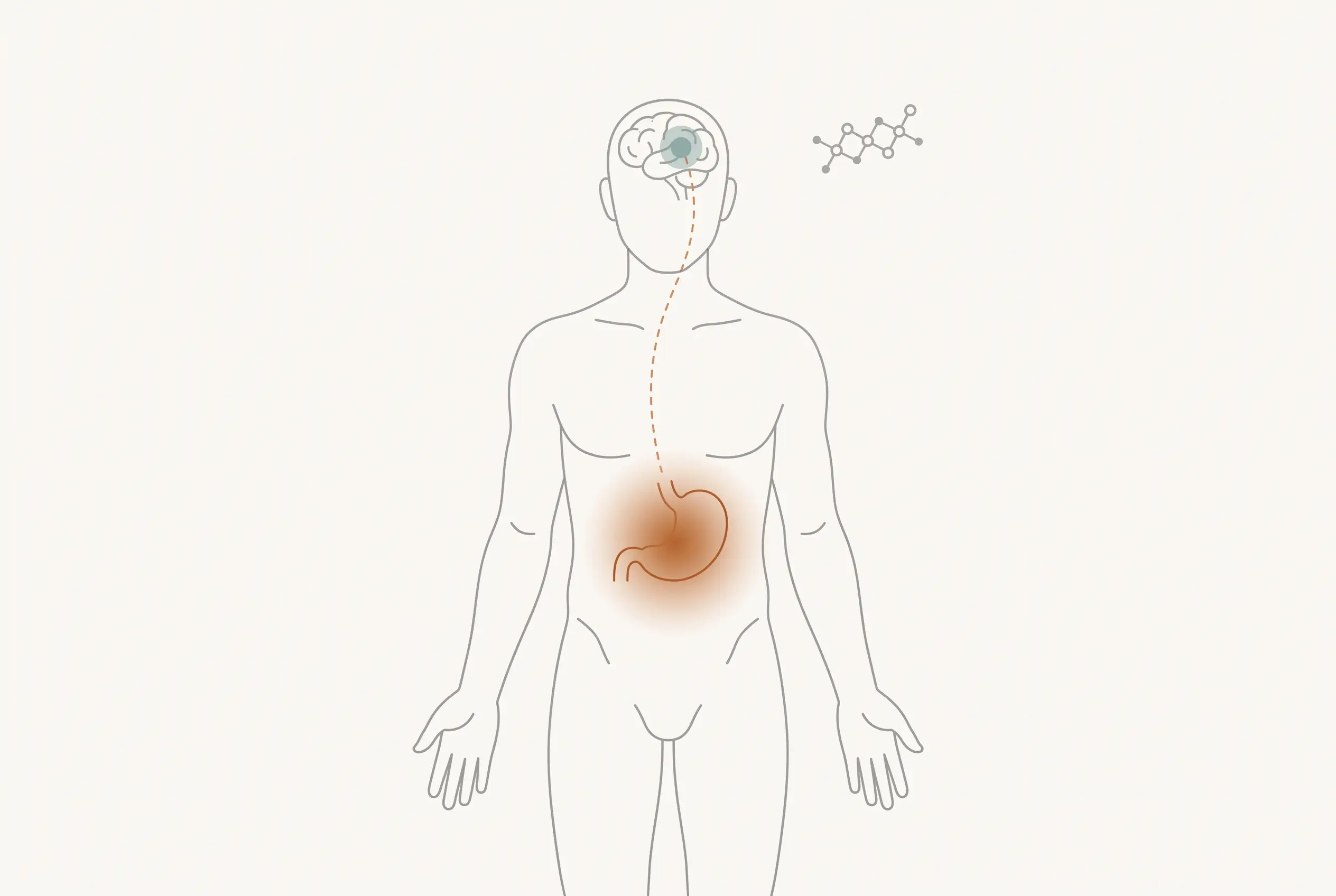
Ecnoglutide (lab code XW003) is a peptide: a short chain of amino acids, which are the tiny building blocks that make up protein. It's man-made and designed to copy a signal your body already uses.
That signal is GLP-1: a hormone your gut releases after you eat, which tells your brain you're full and slows how fast food leaves your stomach. It's the same target as semaglutide, the drug in Ozempic and Wegovy. Switching it on curbs appetite.
So far, so familiar. The interesting part is the word biased.
What 'biased' means, in plain English
When a hormone lands on a receptor (think of a key fitting a lock), the lock doesn't do just one thing. It sets off several different chains of events inside the cell at once. With GLP-1, two of them matter here:
- cAMP: the chain that does the useful work: helping your body release insulin and curbing appetite.
- Receptor internalization: the cell's way of pulling the lock inside and putting it away, which makes it less responsive next time.
Ecnoglutide was engineered to trigger the first one hard and mostly skip the second. That's what 'cAMP-biased' means: it's picky about which chain it sets off. The theory is that a receptor you don't keep putting away stays useful for longer. Whether that translates into a real advantage for patients is a different question, and it's one the trials haven't actually answered, because nobody has run the head-to-head study that would settle it.
It's developed by Sciwind Biosciences, based in Hangzhou, China. The oral tablet version is licensed to Verdiva Bio for territories outside Greater China and South Korea, and is being tested separately from the approved injection.
Does ecnoglutide actually work?
The evidence is strong for this kind of drug, and stronger than for most things covered on this site. Ecnoglutide has finished, published Phase 3 trials in people, the large final stage of testing, in respected medical journals.
| Trial | What it tested | What it found |
|---|---|---|
| SLIMMER (Phase 3, obesity, published 2025) | 664 adults in China with overweight or obesity and no diabetes, over 40 weeks, against a placebo (a dummy injection) | Average weight loss of about 9% to 13% depending on the dose, versus essentially none on placebo. 77% to 87% of people on ecnoglutide lost at least 5% of their body weight, versus 16% on placebo |
| EECOH-2 (Phase 3, type 2 diabetes, published 2025) | 623 adults in China with type 2 diabetes already taking metformin, over 52 weeks, head-to-head against dulaglutide (an approved diabetes drug) | At least as good as dulaglutide at lowering blood sugar (HbA1c). The higher dose did slightly better with statistical significance, but the authors said the difference was not clinically relevant |
| EECOH-1 (Phase 3, type 2 diabetes, published 2026) | 211 adults in China with type 2 diabetes not controlled by diet and exercise alone or one oral diabetes drug, over 24 weeks, against placebo | Clear blood sugar reductions versus placebo |
| Ongoing | Sleep apnea and knee osteoarthritis with obesity, teenagers, an oral tablet version | Not finished |
There's one real limitation worth naming, and it isn't a knock on the science: every published Phase 3 trial was done in China, in Chinese participants. That's a perfectly valid population to study, but regulators like the FDA generally want data that reflects the population they're approving for. It's part of why an approval in one country doesn't automatically travel to another.
It's also worth being honest about how ecnoglutide stacks up. A 2026 review in the BMJ pooled 262 obesity-drug trials covering nearly 100,000 people. It put ecnoglutide in a group of newer drugs that may produce weight loss similar to or greater than the established options, but rated that evidence low to very low certainty, while the evidence for tirzepatide and semaglutide was rated moderate to high. Fewer trials, less certainty. That's not a scandal; it's just what 'newer' means.
And the side effects are not a footnote. Gut problems (nausea, vomiting, diarrhea) are the running theme across this entire family of drugs, and ecnoglutide is no exception. The reassuring part from the trials is that few people quit over them: in EECOH-2, only about 3-4% of people stopped treatment because of side effects, which was in line with the comparison drug.
In adults with obesity or overweight without diabetes (type 1 or 2), individuals administered ecnoglutide had superior and sustained reduction in bodyweight versus placebo with a favourable safety profile, supporting its potential use for weight management.
The Lancet Diabetes & Endocrinology, 2025 (PMID 40555243)
What the research and approvals show
- Finished Phase 3 trials in people, published in The Lancet Diabetes & Endocrinology and Nature Communications
- Substantial weight loss versus placebo in a large Phase 3 trial
- Blood sugar control at least as good as dulaglutide, an approved drug, head-to-head
- Two NMPA approvals in Mainland China in 2026, for type 2 diabetes and for weight management
What they do NOT show
- That it's approved in the US or authorized in the EU: we found neither as of September 15, 2026
- That the data transfers cleanly to other populations, since every Phase 3 participant was studied in China
- That the 'biased' design actually helps patients, which is a theory, not a proven advantage
- That it beats semaglutide or tirzepatide: no published head-to-head trial shows that, and a pooled review rates its evidence low certainty
- That a vial bought online is the approved product, or is safe, or is even ecnoglutide
Who talks about it, and why to be careful
Ecnoglutide gets pushed hard by grey-market sellers, and the fresh China approvals are the selling point: 'it's an approved drug now!' Read that carefully. It's approved there, for a specific product, made under inspection, given to patients whose doctors are watching them. None of that describes an unlabeled vial shipped internationally. If anything, the fact that a legitimate approved version now exists makes the counterfeit market around it more attractive, not less: there's a real name to trade on.
The 'biased agonist' angle gets used the same way. It sounds like a technical upgrade, and it makes for a great sales line. It's a legitimate piece of engineering with a plausible rationale, and it's still an unproven advantage.
What this does not mean
- This does not mean ecnoglutide is approved where you live. As of September 15, 2026, we found approvals only in Mainland China.
- This does not mean the China approvals make online "research" versions legitimate. Those are unregulated copies, not the approved product.
- This does not mean the oral tablet version is approved. It is still in trials.
- This does not mean the trial results automatically apply to everyone. Every published Phase 3 trial was run in China.
- This does not mean the 'biased' design is a proven advantage over ordinary GLP-1 drugs; that hasn't been tested head-to-head.
- This is general education, not medical advice or a recommendation to use ecnoglutide.