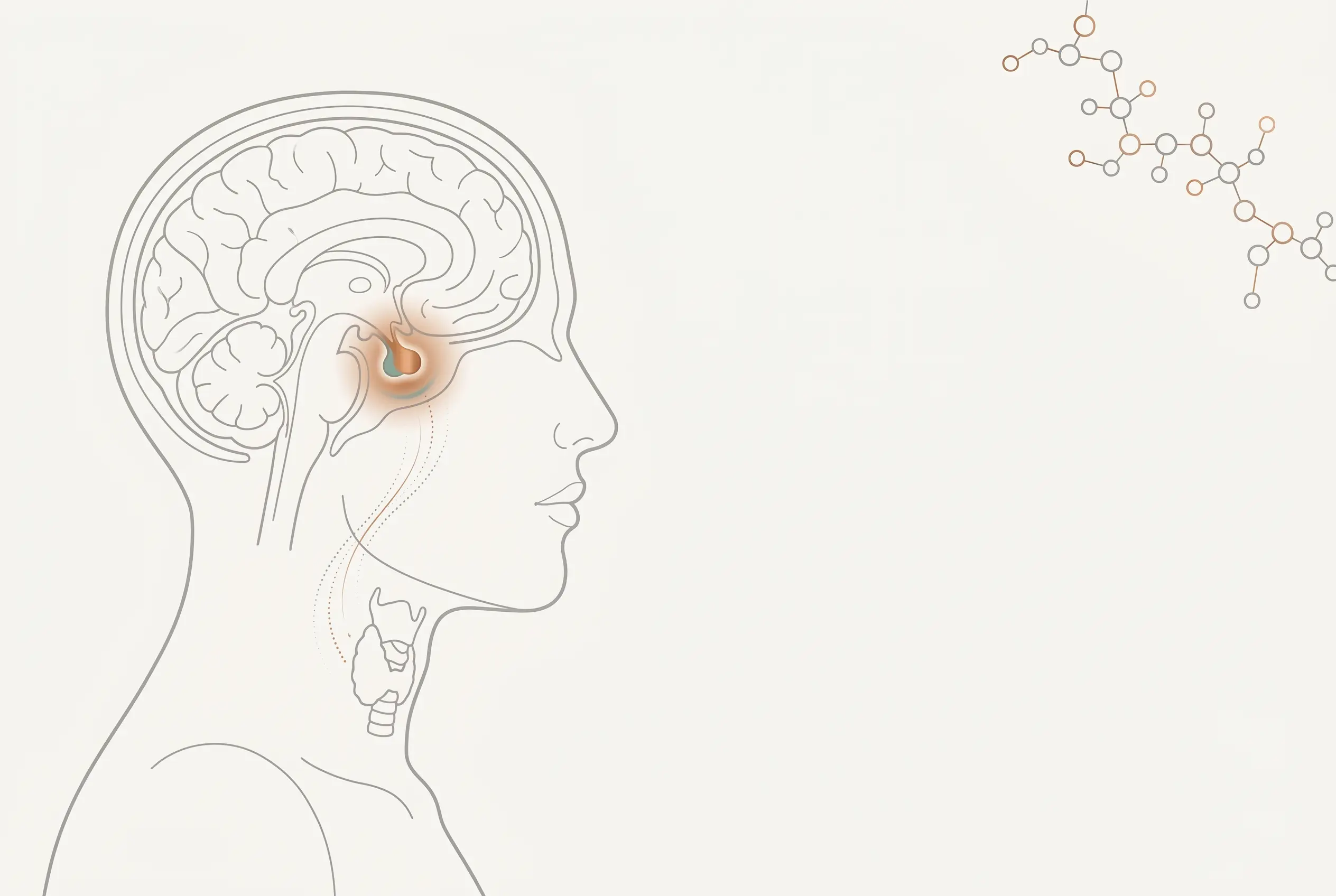
This comparison usually gets flattened into 'sermorelin is legal, ipamorelin isn't,' which is true but skips the more interesting question: what has actually been tested, in whom, and with what result? On that measure these two aren't close. Let's do it properly. No doses, no protocols.
What's the actual difference?
Your pituitary gland releases growth hormone when it gets told to. There are two separate signals that can do the telling, and these peptides copy one each.
Sermorelin copies GHRH: growth-hormone-releasing hormone, the body's main, purpose-built instruction to release growth hormone. It's working with the system's front door. Ipamorelin copies ghrelin, the hunger hormone, which happens to trigger growth-hormone release through a different receptor. It's using a side door that also happens to open the same room. Different signals, different receptors, same end result: a pulse of growth hormone.
That difference is why they're sometimes talked about as complementary rather than as rivals. But the more useful split, and the one nobody leads with, is what's been proven about each.
The head-to-head
| Factor | Sermorelin | Ipamorelin |
|---|---|---|
| What it is | A GHRH copy: mimics the body's own growth-hormone signal | A ghrelin-receptor secretagogue: copies the hunger hormone's signal |
| Approved? | Was FDA-approved as Geref; still legally prescribed via compounding pharmacies | No, never approved anywhere; sold as 'research use only' |
| What it's studied for | Growth-hormone deficiency in children; growth-hormone testing | Growth-hormone release, body composition, recovery, sleep |
| Strength of evidence | Human clinical trials, including a 110-child multicentre study | Animal only for the key findings: rats, pigs, cell cultures |
| Raises cortisol? | No | No, that was its whole design goal, unlike GHRP-2 and GHRP-6 |
| Who supervises it | A doctor, with a prescription and a pharmacy | Nobody: you and a website |
| Banned in sport? | Yes (WADA prohibited) | Yes (WADA prohibited) |
Sermorelin: the one with human trial data
Sermorelin's résumé is unusual for a peptide people discuss online: it has been tested in actual patients, in published multicentre trials, with measured outcomes.
In one study, 110 children with growth-hormone deficiency were treated for up to a year. Their growth rate roughly doubled (from about 4 cm a year before treatment to around 7-8 cm a year during it), and the researchers reported it was well tolerated, with no adverse changes in the biochemistry they tracked. A separate study in children whose growth-hormone deficiency was caused by radiation treatment found a similar improvement in growth rate, though not as large as with growth hormone itself.
Be clear about what that does and doesn't show. Those trials were in growth-hormone-deficient children with a diagnosed medical problem. They are not evidence that sermorelin does anything for a healthy adult chasing recovery or body composition. But they're real human data, which is more than almost anything else in this category can claim.
Ipamorelin: the one whose famous study was in animals
Ipamorelin's reputation rests almost entirely on one 1998 paper, and it's worth knowing exactly what that paper was.
Researchers were looking for a growth-hormone secretagogue that didn't drag other hormones up with it. The older peptides, GHRP-2 and GHRP-6, reliably raised ACTH and cortisol, your stress hormones. Ipamorelin didn't, even at doses far above what was needed for growth hormone. That's a genuinely elegant result, and it's why 'selective and gentle' has followed ipamorelin around ever since.
The work was done in rat pituitary cells, anaesthetised rats, and conscious pigs. The paper's own conclusion was that this made ipamorelin an interesting candidate for future clinical development. That development never produced an approved medicine. Twenty-plus years later, the headline claim about ipamorelin is still resting on animal data, and it's still sold as a research chemical.
Which one is safer?
Sermorelin, and not because of the molecule. Because of everything around it.
Sermorelin comes with a diagnosis, a prescribing doctor, a compounding pharmacy that has to meet standards, and someone accountable if something goes wrong. Ipamorelin comes with a website. Nobody has verified the identity, purity, or sterility of what's in a research vial, and you're injecting it. That gap in oversight is a bigger safety factor than any difference in how the two peptides work.
Two honest caveats. Sermorelin being prescribable doesn't make it appropriate for you: that's a doctor's call based on an actual diagnosis, and the human evidence sits in deficiency, not in healthy adults wanting an edge. And both are on the WADA prohibited list, so for a tested athlete the legal difference is irrelevant: both end careers.
Which one is better?
If you're comparing what's been demonstrated rather than what's been claimed, sermorelin wins and it isn't close. Human trials, published outcomes, an approval history, a supervised route to access. Ipamorelin has a clever animal study, a good story about selectivity, and no approval anywhere in the world.
The catch is that winning this comparison doesn't mean sermorelin is something to go get. Its evidence is in diagnosed deficiency, and the honest answer for most people asking this question is that neither peptide is the right answer to their actual goal. If you suspect a genuine growth-hormone problem, that's a diagnosis a doctor makes with a test, and sermorelin's real history is as part of that medical process, not a shortcut around it.
What's actually true
- Sermorelin copies GHRH; ipamorelin copies ghrelin: different signals, different receptors
- Sermorelin was FDA-approved as Geref and is still prescribed through compounding pharmacies
- Sermorelin has published human trials, including in 110 growth-hormone-deficient children
- Ipamorelin's selectivity finding (growth hormone without a cortisol rise) came from rats and pigs
- Both are prohibited in sport under WADA
What's just hype
- 'Ipamorelin is clinically proven to be gentle and selective': that finding is animal data
- 'Sermorelin's trial results apply to healthy adults': they were in children with a diagnosed deficiency
- 'Ipamorelin is basically sermorelin without the prescription': different mechanism, and no oversight at all
- 'Research-grade ipamorelin is quality-checked': nobody verifies what's in the vial
The honest verdict
Sermorelin and ipamorelin push the same button through different doors: GHRH signal versus ghrelin signal. Where they really diverge is proof. Sermorelin has human trials, an approval history, and a doctor attached. Ipamorelin has an elegant animal study, a persistent reputation, and no approval anywhere. Both are banned in sport. If growth hormone is a genuine medical question for you, the route is a diagnosis and a doctor, not a research vial and a forum thread.
What this does not mean
- This doesn't mean sermorelin is proven to help healthy adults. Its human trial evidence is in children with diagnosed growth-hormone deficiency.
- This doesn't mean ipamorelin's 'gentle and selective' reputation is confirmed in people. That finding comes from rats and pigs.
- This doesn't mean sermorelin's prescription status makes it a wellness product. It's a medicine used for a diagnosed problem.
- This is general info, not medical advice: a doctor decides whether any growth-hormone-related peptide fits you.