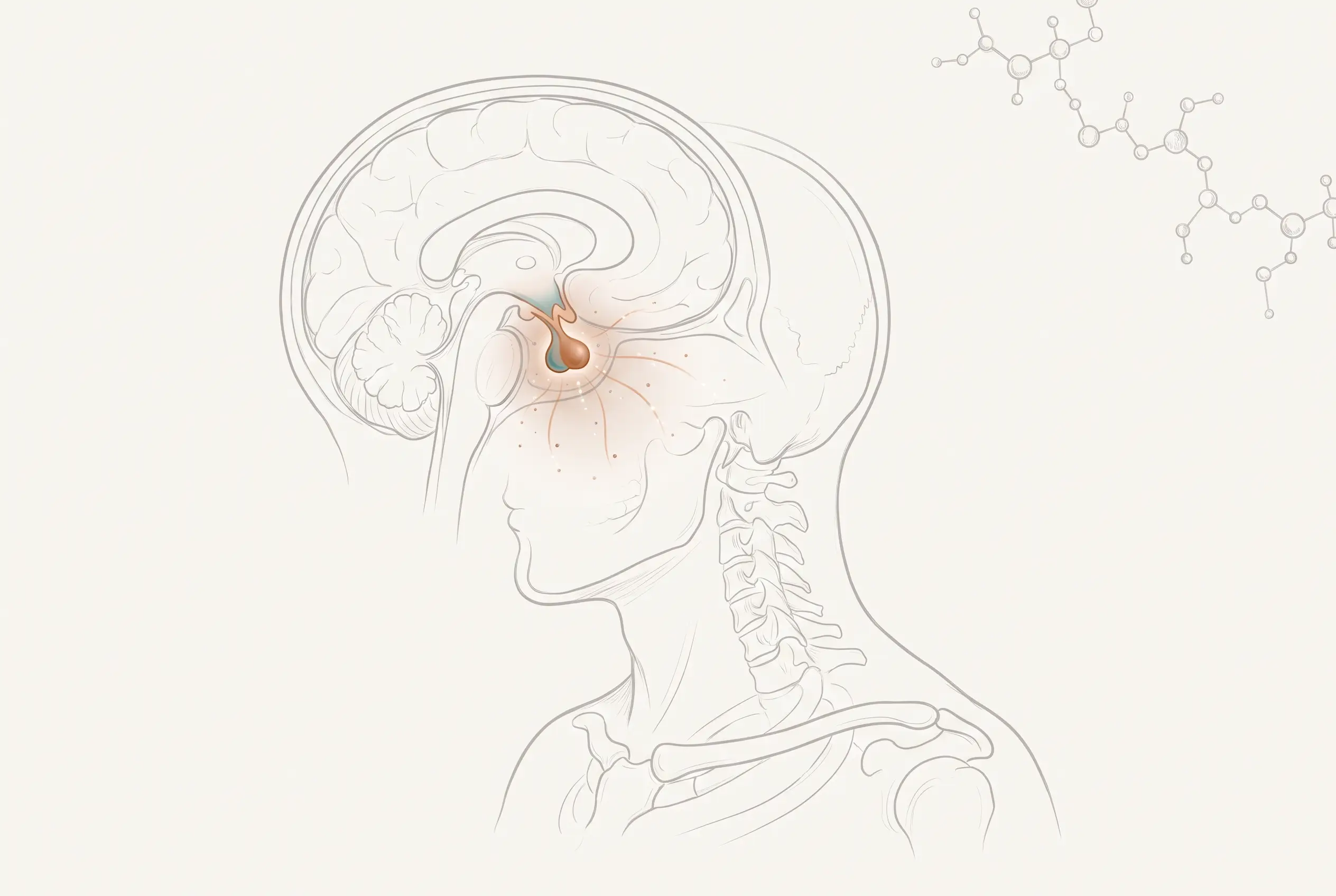
GHRP-2 and GHRP-6 are the old guard. Before ipamorelin and CJC-1295 took over the conversation, these two were the growth-hormone peptides everyone argued about. They're still sold, still compared, and the differentiator everyone cites is the same one it's always been: hunger. Here's the honest version. No doses, no protocols.
What's the actual difference?
Both are 'secretagogues': a word that just means something that makes your body secrete more of a substance. In this case, growth hormone. They do it by acting on the ghrelin receptor, the docking point for ghrelin, the hormone that makes you feel hungry. That's the key to the whole comparison: these peptides are pulling a hunger lever to get a growth-hormone effect. The side effect is baked into the mechanism.
GHRP-6 is the original and the blunt one. It reliably produces an intense, hard-to-ignore hunger. This was actually one of the first non-growth-hormone effects researchers noticed about this whole class of peptides. GHRP-2, also called pralmorelin, came later and is more selective: it still triggers growth hormone release, with less of the ravenous appetite. That's the entire practical distinction most people care about.
The head-to-head
| Factor | GHRP-2 | GHRP-6 |
|---|---|---|
| What it is | A synthetic growth-hormone-releasing peptide, also called pralmorelin | The original synthetic growth-hormone-releasing hexapeptide |
| How it works | Acts on the ghrelin receptor to trigger a growth-hormone pulse | Acts on the ghrelin receptor to trigger a growth-hormone pulse |
| Approved? | Approved in Japan as a diagnostic agent for growth-hormone deficiency; not approved in the US | No, sold as 'research use only' |
| What it's studied for | Testing for growth-hormone deficiency; short stature (early trials) | Growth-hormone release; appetite; a range of animal tissue-protection studies |
| Strength of evidence | Some early human data, mostly as a diagnostic test | Weak for human benefit: recent work is animal-only |
| Hunger effect | Present but noticeably milder | Strong: the defining feature |
| Raises cortisol? | Yes, raises ACTH and cortisol | Yes, raises ACTH and cortisol |
| Banned in sport? | Yes (WADA prohibited) | Yes (WADA prohibited) |
GHRP-6: the hungry one
GHRP-6's appetite effect isn't a quirk, it's the headline. Because it works through the ghrelin receptor, it hits the same system that makes you hungry before dinner, and it hits it hard. In the fitness world this gets framed as a feature for people trying to eat more; in practice it's an unpredictable, intense hunger you don't control.
The evidence picture is honest and unflattering. The recent research is animal work: studies on protecting rodent hearts from chemotherapy damage, and on kidney injury in animals. Interesting biology. Not evidence that GHRP-6 does anything useful or safe in a healthy person.
GHRP-2: the more selective one
GHRP-2 is the refined version of the same idea. Under the name pralmorelin, it was developed as a diagnostic agent (a way to test whether someone's body can produce growth hormone properly), and it reached approval for that specific use in Japan. It also went into early trials for short stature. That's more of a real medical footprint than most peptides in this category have.
It's still not a general-purpose approved medicine, though, and it isn't approved in the US. The 'more selective' framing also has a limit: GHRP-2 still raises ACTH and cortisol, your stress hormones. When researchers developed ipamorelin later, the whole selling point was that unlike both GHRP-2 and GHRP-6, it released growth hormone without pushing cortisol up. So GHRP-2 is cleaner than GHRP-6, and still not clean.
Which one is safer?
Neither is 'safe' in any way you can rely on, but if you're forced to rank them, GHRP-2 is the milder of the two: less appetite disruption, and a real (if narrow) approved use somewhere in the world.
The shared problems don't go away, though. Both raise cortisol. Both can affect insulin sensitivity, which matters for blood sugar. A review of growth-hormone secretagogues as a class was blunt about it: there are very few long-term, rigorously controlled human studies, and the long-term safety picture (including cancer risk and mortality) hasn't been worked out. And every vial of either one sold to consumers is an unregulated research chemical nobody has checked.
Is either one legal?
In the US, neither is an approved medicine. Both are sold as 'research use only' chemicals, which is a labeling workaround, not a quality guarantee. GHRP-2 has an approval in Japan as a diagnostic agent. That's a real approval, but for a hospital test, not for anyone's physique goals.
For athletes there's no ambiguity at all: growth hormone secretagogues are on the WADA prohibited list. Both of these are banned, in and out of competition. A positive test ends seasons and careers.
What's actually true
- Both act on the ghrelin receptor to trigger growth-hormone release
- GHRP-6 causes strong hunger; GHRP-2 causes noticeably less
- Both raise ACTH and cortisol; ipamorelin was later designed specifically to avoid that
- GHRP-2 (pralmorelin) is approved in Japan as a diagnostic agent for growth-hormone deficiency
- Both are prohibited in sport under WADA
What's just hype
- 'GHRP-2 is the safe version': it's milder on hunger, not proven safe
- 'The hunger is a bonus for bulking': it's an uncontrolled effect on a hormone system
- 'Recent studies show they work': the recent GHRP-6 work is in animals
- 'Research-grade vials are quality-checked': nobody verifies what's inside
The honest verdict
GHRP-2 and GHRP-6 are two versions of the same old idea, separated mostly by how hungry they make you. GHRP-2 is milder and has a narrow diagnostic approval in Japan; GHRP-6 is the blunt original whose recent evidence is animal-only. Both raise cortisol, both lack long-term human safety data, both are unapproved in the US, and both are banned in sport. This isn't a 'pick the winner' comparison. Talk to a doctor before going near this category.
What this does not mean
- This doesn't mean GHRP-2 is the safe option. It's milder on appetite, but it still raises cortisol and lacks long-term human safety data.
- This doesn't mean GHRP-6's hunger effect is a useful bulking tool. It's an uncontrolled effect on the same system that governs appetite.
- This doesn't mean GHRP-2's Japanese approval makes it available for general use. That approval is for a hospital diagnostic test.
- This is general info, not medical advice. Growth-hormone issues need a doctor's diagnosis, not a research vial.